To be able to handle ever-increasing data loads, the industry’s largest long-distance cloud companies have moved to 100G Ethernet along with other core network data center operators.
However, most operators believe that for server connections, their workloads only need incremental improvements on the 10G network.
1.Data Center
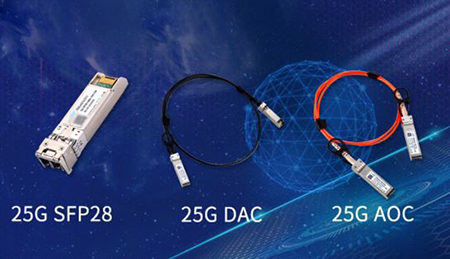
When the server speed starts to migrate from 10G to higher speed, the current 10GE optical fiber and other basic components have already been built. During the upgrade, switching to 40GE will cause a lot of resource investment, and the original investment cannot be protected. , but 25GE is fully compatible with the relevant physical standards of 10GE, which can achieve fast switching and protect the original investment.Therefore, from the perspective of resource investment and cost, 25GE will be the best choice for server upgrades. Optical interconnect products for 25G servers include 25G SFP28 optical modules, 25G DAC high-speed cables, and 25G AOC active optical cables.
1. 5G base station
Whether a 5G base station uses a 25G optical module or a 100G optical module depends on the interface protocol. In the case of the same transmission content, the CPRI protocol is used, and the effect is good, but the rate of the optical module must be large enough, and the eCPRI protocol is used. Poor, but the optical module is cheap and can use low speed.Different operators choose different protocols and data compression ratios. Choosing CPRI has less distortion and better effect, but needs to choose higher rate optical modules.
The introduction of new 5G service features, the innovation and changes of the wireless access network structure and core network architecture have provided opportunities for a new round of rapid development of bearer technology. In terms of data centers, the existing 100G standard network system consists of four links. The bandwidth of each channel is 25Gbps, making it easier for network operators to expand their data centers.
FAQs About 25G Transceivers
What are the advantages of 25G SFP28 modules?
25G modules offer a significant increase in bandwidth, making them a compelling choice for modern data centers and enterprise networks. Their advantages include a smooth upgrade path from 10G, cost efficiency compared to higher-speed alternatives, compatibility with existing fiber infrastructure, and support for industry standardization, ensuring interoperability. Additionally, 25G SFP28 modules play a crucial role in various applications such as cloud computing and 5G networks.
What types of 25G SFP28 transceivers are available in the market?
25G modules offer a significant increase in bandwidth, making them a compelling choice for modern data centers and enterprise networks. Their advantages include a smooth upgrade path from 10G, cost efficiency compared to higher-speed alternatives, compatibility with existing fiber infrastructure, and support for industry standardization, ensuring interoperability. Additionally, 25G SFP28 modules play a crucial role in various applications such as cloud computing and 5G networks.
What are the applications for different types of 25G transceivers?
Each type of module is optimized for specific network applications and distance requirements. Following are the specific applications of different types of modules:
- 25G SFP28 (SR、LR、ER、ESR、CSR、BIDI): They are mainly used for the interconnection of data center servers, switches and routers;
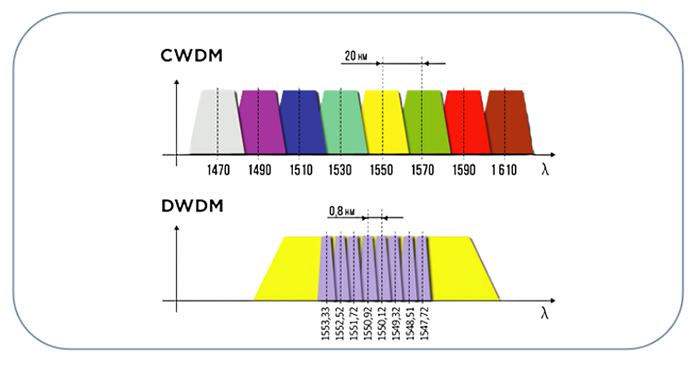
- 25G CWDM SFP28: It is used in 25G Ethernet switches, routers, network interface cards (NICs) and storage network equipment, and can well solve the 5G millimeter wave fronthaul problem at the current stage;
- 25G DWDM SFP28: It is used to meet the needs of 5G fronthaul services and is widely used in CPRI/eCPRI links on 25G Ethernet and single-mode SMF, where the wavelengths are tightly packed together to increase the bandwidth of the existing optical fiber network.
What are SR and LR?
SR is Short Reach, and generally refers to transceivers that operate over MMF up to a few 100 meters. LR is Long Reach, and generally refers to transceivers that operate over SMF at up to 10km.
What is a 25G SFP28 dual-rate module?
Dual rate supports two rate types. The 25G dual module rate can support both 10G and 25G rates, and rate switching can be performed on the supported device ports.
When is FEC needed for 25G SFP28?
FEC decreases the BER to 10(-1)(2). For 25G, RS-FEC is used when the pre-FEC BER is above 5×10(-5) and FC-FEC is used when the pre-FEC BER is above 10(-8).
What does “breakout” mode mean?
“Breakout” mode in networking refers to the ability of a high-speed network link, typically provided by a multi-lane interface like a high-speed optical fiber link, to be split into multiple lower-speed links. This is often done using breakout cables or modules.
Related Article:
SFP-CWGE27-80C 1.25G CWDM SFP 1270nm 80km LC SMF DDM Transceiver Module
TRENDnet TEG-MGBS10 Compatible 1000Base LX SFP 1310nm 10km LC SMF DDM Transceiver Module
SFP-GE35-2BX20 1000Base 2 Channels BX BIDI CSFP TX1310nm-RX1550nm 20km LC SMF DDM Transceiver Module
SFP-GE55-ZX 1000Base SFP ZX 1550nm 80km LC SMF DDM Transceiver Module
SFP-DWGE17-120C 1.25G DWDM SFP C17 100GHz 1563.86nm 120km LC SMF DDM Transceiver Module