At present, high-speed optical fiber transmission has been widely used in various backbone networks, and Ethernet Passive Optical Network (EPON) has become the preferred solution of relevant operators because of its low cost and time-sharing ability to provide users with high-performance access. With the accelerated deployment of 1Gbps fiber-to-the-home technology in the access network, telecom operators and related industry chains have begun to seek new technologies that can meet the next-generation optical network applications. 10G-EPON technology is a new technology option to meet higher bandwidth requirements. 10G-EPON increases the downlink bandwidth of the optical fiberaccess network by 10 times (10Gbps), and is compatible with the network protocol and topology of the current 1G EPON solution.
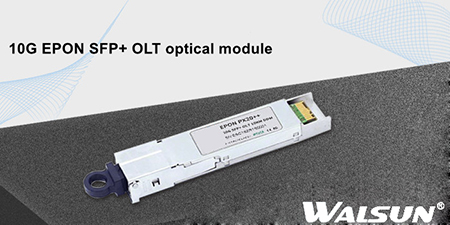
In terms of standard definition, 10G-EPON fully considers the network coexistence with 1G EPON, and defines two types of modes according to the bandwidth of the uplink and downlink rates, namely: asymmetric and symmetric modes. Symmetrical mode refers to the working mode in which both uplink and downlink data are transmitted at 10G rate in the network; asymmetric mode refers to the working mode in which 10G data is transmitted downlink and 1G data is transmitted uplink in the network. Next, ETU-Link will introduce the 10G EPON optical modulefor you.
1.10G SFP+ EPON OLT(10G/1G)
It adopts SFP+ package type, SC connector, belongs to single-fiber bidirectional BiDi optical transceiver, and the longest transmission distance can reach 20 kilometers. The 10G bidirectional link is configured with 1270nm/1577nm optical devices, and the 1G link is configured with 1310nm/1490nm optical devices. The 1270nm and 1310nm optical burst mode receivers feature APD/TIA optics for maximum sensitivity. The 10G transmitter uses 1577nm EML DFB laser components, and the 1G transmitter uses 1490nm DFB laser components.
2.10G SFP+ EPON ONU(10G/1G)
It adopts SFP+ package type and SC connector. It is a single-fiber bidirectional BiDi optical transceiver with a maximum transmission distance of 20 kilometers. It is designed for low-cost point-to-multipoint (P2MP) fiber-to-the-home (FTTH), commercial or curb ) application and designed.It adopts 1577nm CW mode downlink ADP/TIA receiver, working speed is 10.3125Gb/s, 1310nm DFB burst mode uplink transmitter, working speed is 1.25Gb/s.It can be backward compatible with traditional Gigabit Ethernet PON system, including monitoring function Txuburst and RxuLOS, complies with FDA 21CFR1040.10 and IEC 60825-2.I class laser safety standard, EEC directive 2002/95 /EC RoHS standard.
The above are the two 10G EPON optical modules introduced by Walsun. EPON optical modulesare of great significance for reducing the cost of FTTX systems.
Related Article:
Where to Use 100G QSFP28 Optical Modules in Data Centers
What Is the Introduction to 100G QSFP28 SR BiDi Optical Modules
How to Differentiate Between 10G DWDM SFP+ Tunable and Conventional DWDM Optical Modules
What Is the Connection Solution Between a 12-Core Optical Fiber Distribution Box and 40G100G Optical Modules
What Are the Cost-Effective Solutions for 100G QSFP28 Dual-Fiber Single Lambda Optical Modules