The traditional computing network of data centers is composed of the access layer, the convergence layer and the core layer. However, with the rapid growth of new applications and the amount of data, the requirements on the network architecture are constantly raised. Therefore, a new network topology architecture — leaf-spine structure is born in the data center. Now, Walsun will introduce the structure of leaf-spine.
Compared with the traditional three-tier architecture, the leaf-spine two-tier architecture has the advantages of saving resources, reducing delays, transmitting multiple lines, and increasing the number of fiber interfaces.
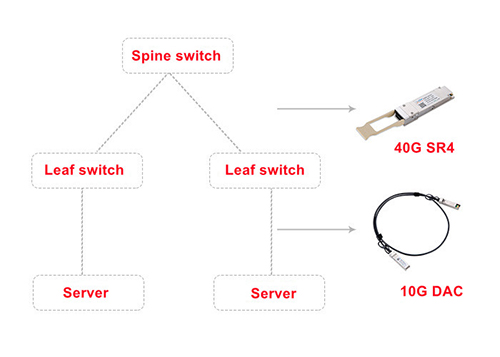
When constructing the Leaf-spine network, we need leaf and spine switches, and the interconnection of ridge and leaf switches should match each other. In general, the reasonable bandwidth ratio between ridge switches should not exceed 3:1.For example, with 48 10Gbps ports on a leaf switch, the expected bandwidth required is 480 GBPS. If a blade switch uses four 40 Gbit/s uplink ports to connect to a ridge switch, its bandwidth will be 160 Gbit/s, so the ratio will be 3:1 without overload. This bandwidth ratio should be paid special attention to when designing the blade ridge network.
In consideration of cost, 10G DAC direct attach cable can be used to connect 10G server and switch in the top-type wiring of TOR rack; 40G SR4 multi-mode optical module with OM3 fiber patch cord can be used to connect leaf switch and spine switch.
Optical module has the characteristics of long transmission distance and small attenuation, which has irreplaceable advantages in large-scale network deployment. In addition, when deploying a blade ridge network in a data center, you must consider the number of clients, bandwidth requirements, and distance to select the required optical module type. With the popularity of the leaf-spine network architecture, the optical module requirements of data centers will be upgraded from 10/40G to 25/100G or higher, which will drive the growth of the demand for 100G or higher optical modules.
Related Article:
SFP-GE35-2BX20 1000Base 2 Channels BX BIDI CSFP TX1310nm-RX1550nm 20km LC SMF DDM Transceiver Module
SFP-GE55-ZX 1000Base SFP ZX 1550nm 80km LC SMF DDM Transceiver Module
SFP-DWGE17-120C 1.25G DWDM SFP C17 100GHz 1563.86nm 120km LC SMF DDM Transceiver Module
How to Apply 400G QSFP-DD FR4 Optical Modules in Your Network
How AI is Innovatively Converging with Ethernet, Optical Modules, and InfiniBand