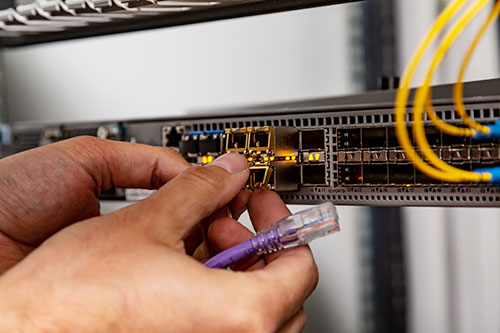
Extreme 10GB-BX20-DCompatible 10G SFP+ BiDi transceivers support up to 20km over single LC SMF fiber, following IEEE 802.3ae and SFP+ MSA 10GBase-LR. The SFP+ transceivers are high-performance, cost-effective modules. The transceiver module complies with SFP+ MSA specifications (SFF-8431, SFF-8432, SFF-8472), 10 Gigabit Ethernet specifications (10GBASE-LR/LW per IEEE 802.3ae ), and 10G Fibre Channel.
Product Details
| Extreme Compatible | 10GB-BX20-D | Vendor Name | Walsun |
| Form Factor | SFP+ | Max Data Rate | 10.7Gbps |
| Wavelength | TX1330nm/RX1270nm | Max Distance | 20km |
| Connector | Simplex LC | Transmitter Type | 1330nm DFB |
| Cable Type | SMF | Receiver Type | PIN |
| TX Power | -3.0~+2.0dBm | Receiver Sensitivity | < -14.4dBm |
| Protocols | 10G Ethernet, MSA Compliant | Operation Temperature | 0 to 70°C (32 to 158°F) |
What is the difference between 10G SFP+ and C/DWDM SFP+ modules?
The main difference between 10G SFP+ and 10G Coarse or Dense Wavelength Division Multiplexing (C/DWDM) SFP+ modules lies in their functionality and application:
1. 10G SFP+ Modules: These modules are standard 10 Gigabit Ethernet transceivers used for transmitting data over short to medium distances. They operate on a single wavelength and are commonly used in traditional Ethernet networks for distances up to 300 meters over multimode fiber or up to 40 kilometers over single-mode fiber.
2. 10G C/DWDM SFP+ Modules: These modules utilize C/DWDM technology, allowing multiple wavelengths of light to be transmitted simultaneously over a single fiber. CWDM typically supports fewer channels over wider wavelength spacing, while DWDM offers more channels with narrower spacing. C/DWDM SFP+ modules are used for long-distance transmission and increasing network capacity by multiplexing multiple signals onto a single fiber pair.
In summary, both 10G SFP+ and 10G C/DWDM SFP+ modules transfer data at 10 Gigabit Ethernet rates, while the latter has the added capability of multiplexing several signals across a single fiber for longer-distance and higher-capacity applications.
What is the difference between 10G SFP+ and BiDi SFP+ transceivers?
The key distinction is the number of optical fibers needed for bidirectional communication:
1. Traditional 10G SFP+ Transceivers:
Standard 10G SFP+ transceivers utilize two fibers, one for transmitting and one for receiving data.
They typically operate with two different wavelengths for bidirectional communication, requiring separate fibers for each direction.
2. BiDi SFP+ Transceivers:
BiDi (Bidirectional) SFP+ transceivers use WDM technology to enable bidirectional communication over a single fiber.
They transmit and receive data on the same fiber but at different wavelengths, simplifying cabling infrastructure and reducing fiber count.
While traditional 10G SFP+ transceivers require two fibers for bidirectional communication, BiDi SFP+ transceivers achieve the same functionality using only one fiber, making them advantageous in situations where fiber availability or infrastructure complexity is a concern.
Frequently Asked Questions About 10GBASE-T SFP+ Module
Q: What cables are supported with 10GBASE-T SFP+ modules?
A: The module is compatible with 10GBASE-T, 1000BASE-T, and 100BASE-T. The Supported cables as below:
| Speed | Cable Type | Max. Cable Distance |
|---|---|---|
| 10GBASE-T | Cat 6a | 30m-50m |
| Cat6a shielded/Cat 7 | 80m-100 m | |
| 1000BASE-T / 100BASE-T | Cat 6/Cat 6a /Cat5e | 100m |
Q: Can the 10GBASE-T be used at low temperatures?
A: The 10GBASE-T is available in commercial and industrial versions. Standard products are suitable for operating temperature range of 0~70 °C. For a wider temperature range, it is recommended to purchase industrial modules (-40 to 85°C) .
Q: What are their differences of 10GBASE-T SFP+ vs SFP+ DAC vs Fiber SFP+?
A:10GBASE-T SFP+, SFP+ DAC, and SFP+ Transceiver are the most commonly used types in the 10G network.
| Comparsion | SFP+ DAC | 10GBASE-T SFP+ | SFP+ Fiber |
|---|---|---|---|
| Media | Integrated copper/fiber | Category 6a or 7 | Fiber Cable (SM/MM) |
| Connector | SFP+ | RJ45 | LC |
| Distance | 15m | 30m-100m | Max 100km |
| Cabling System | No | Copper cabling | Fiber cabling |
| Data rate | 10 Gbps | 10 Gbps | 10 Gbps |
| Power Consumption | 1~1.5w | 2~5w | ~0.7w |
Q: Where can 10GBASE-T be used?
A: If using 10GBASE-T, the places are required to be in the Data Center or horizontal areas (in building, including wiring closet). But it is not suited for vertical (riser links) applications within building, or campus & metro applications.
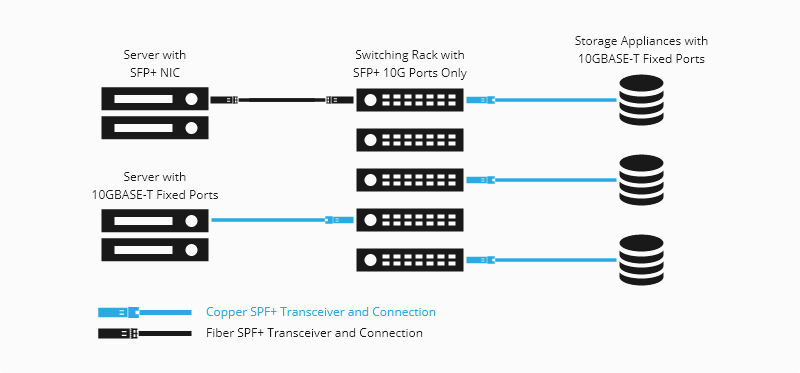
The 10GBASE-T modules are used in Data Center TOR areas.
Cases for 10GBASE-T Ethernet Connections
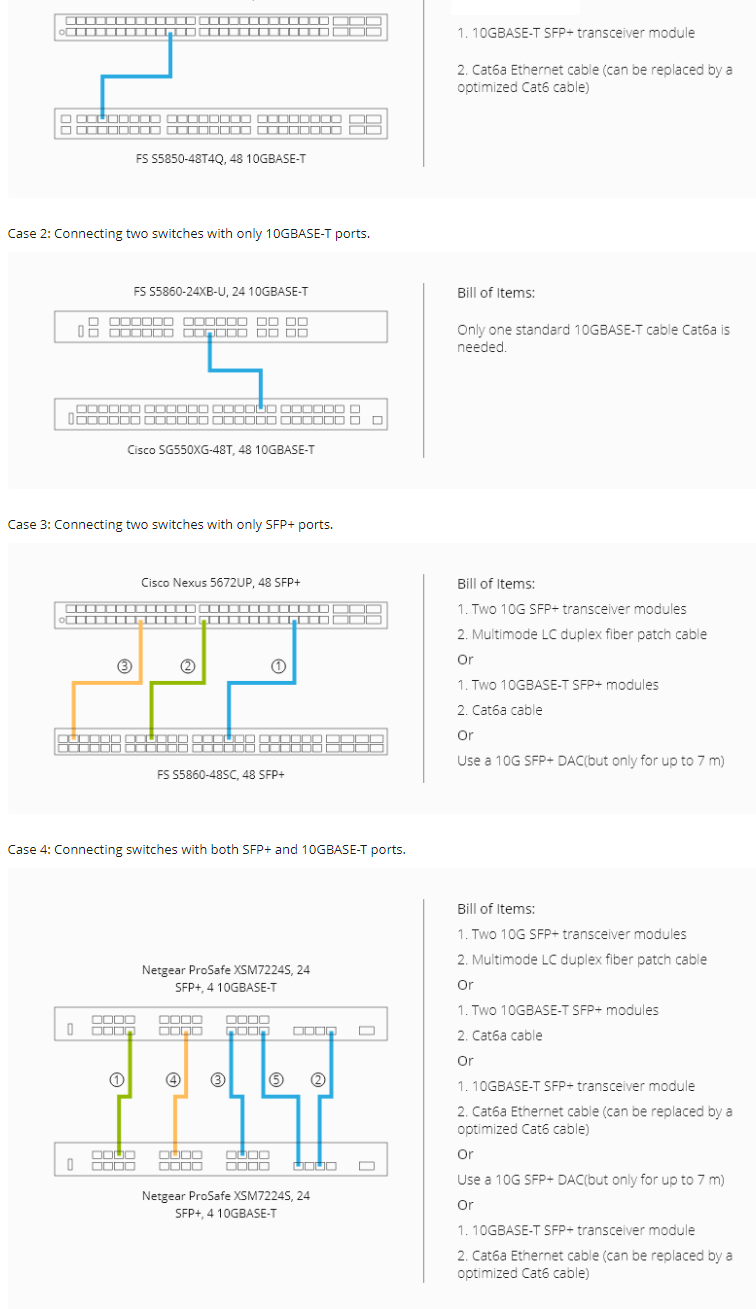
When the two switches both have SFP+ and 10GBASE-T ports, it is recommended to use the 10GBASE-T copper ports first, and save the SFP+ ports for possible future connections to an optical network for longer transmission distance.
Related Article:
Dell SFP-10G-T Compatible 10G T Copper SFP+ 30m RJ45 without DDM Transceiver Module
Dell Force10 GP-10GSFP-1Z-CW47 Compatible 10G CWDM SFP+ 1470nm 80km LC SMF DDM Transceiver Module
Huawei SFP-10G-ER-SM1330-BIDI Compatible 10G ER SFP+ BIDI TX1330nm-RX1270nm 40km LC SMF DDM Transceiver Module
Huawei SFP-10G-ZCW1471 Compatible 10G CWDM SFP+ 1470nm 80km LC SMF DDM Transceiver Module
Extreme 10GB-BX10-U Compatible 10G BX SFP+ BIDI TX1270nm-RX1330nm 10km LC SMF DDM Transceiver Module