Arista Networks SFP-1G-EX1550-40 Compatible 1000Base EX SFP Transceiver Module (1550nm SMF 40km LC DDM)
Product Details
| Arista Networks Compatible | SFP-1G-EX1550-40 | Vendor Name | Walsun |
| Form Factor | SFP | Max Data Rate | 1.25Gbps |
| Wavelength | 1550nm | Max Distance | 40km |
| Connector | Duplex LC | Transmitter Type | 1550nm DFB |
| Cable Type | SMF | Receiver Type | PIN |
| TX Power | -5.0~0dBm | Receiver Sensitivity | < -23.0dBm |
| Protocols | SFF-8472 MSA Compliant, IEEE 802.3ah-2004 | Operation Temperature | 0 to 70°C (32 to 158°F) |
SFP, SFP+, SFP28, QSFP+, QSFP28, What Are the Differences?
The following part will give detailed comparisons of SFP vs SFP+, SFP28 vs SFP+, QSFP vs QSFP28 and SFP28 vs QSFP28.
| Optics Type | Standard | Data Rate | Wavelength | Fiber Type | Max Distance | Typical Connector | DOM | Operating Temperature |
|---|---|---|---|---|---|---|---|---|
| SFP | SFP MSA | 155Mbps 622Mbps 1.25Gbps 2.125Gbps 2.5Gbps 3Gbps 4.25Gbps |
850nm 1310nm 1550nm CWDM DWDM BIDI |
OM1 OM2 OS1 OS2 |
160km | LC SC RJ-45 |
NO or YES | Commercial
Industrial |
| SFP+ | IEE802.3ae SFF-8431 SFF-8432 |
6Gbps 8.5Gbps 10Gbps |
850nm 1310nm 1550nm CWDM DWDM BIDI Tunable Copper |
OM3 OM4 OS1 OS2 |
120km | LC RJ-45 |
YES | Commercial
Industrial |
| QSFP+ | IEEE 802.3ba QSFP+ MSA SFF-8436 SFF-8636 Infiniband 40G QDR |
41.2Gbps | 850nm 1310nm 832-918nm |
OM3 OM4 OS1 OS2 |
40km | LC MTP/MPO |
YES | Commercial
Industrial |
| SFP28 | IEEE 802.3by SFP28 MSA SFF-8472 SFF-8432 |
25.78Gbps | 850nm 1310nm |
OM3 OM4 OS1 OS2 |
10km | LC | YES | Commercial
Industrial |
| QSFP28 | IEEE 802.3bm QSFP28 MSA SFF-8665 SFF-8636 |
103Gbps 112Gbps |
850nm 1310nm CWDM4 |
OM3 OM4 OS1 OS2 |
80km | LC MTP/MPO-12 |
YES | Commercial
Industrial |
How to Choose SFP Transceivers?
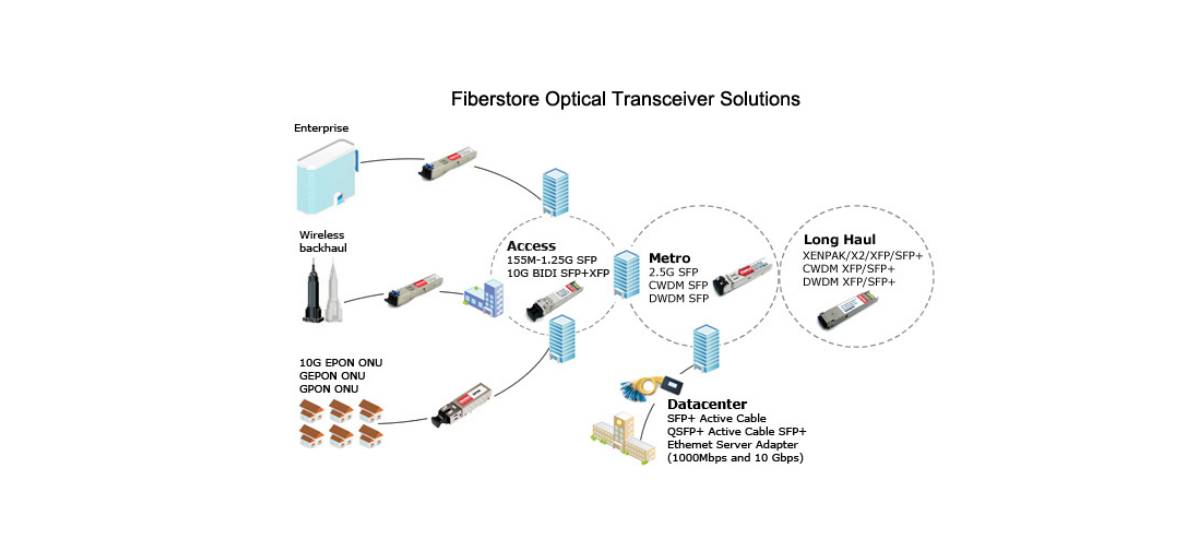
In addition to SFP, SFP+, SFP28, QSFP+, and QSFP28, you also need to consider the application. Different types of SFP transceivers depend on their purpose, such as single-mode versus multimode SFP. Single-mode SFP transceivers work with single-mode fiber, while multimode SFPs are compatible with multimode fiber. In addition, there are long-reach WDM SFP transceivers for multiplexing, simplex SFPs for single-fiber applications, video SFP transceivers for transmitting high-definition video, and PON SFPs for fiber-based access network transceivers. SFPs are available in commercial and extended operating temperature ranges, with or without extended diagnostics.
FAQs about 1G SFP Transceivers
Q: What are the features and benefits that 1G SFP transceivers can offer?
A: 1G SFP transceivers help service providers or enterprises to facilitate high-speed data transmission, and enhance network efficiency at lower cost and power. The six key benefits of 1G SFP transceivers include:
-
- Hot-pluggable SFP MSA compliant to maximize uptime and simplify maintenance.
-
- Lower latency compared to certain wireless network connections.
-
- Low power consumption and improved port density.
-
- The extensive cable distance capability renders them well-suited for long-haul applications, such as metropolitan area networks (MAN) or wide area networks (WAN).
-
- Loss of Signal (LOS) function provides enhancing network reliability and fault detection.
-
- TO coaxial packaging enables high reliability and protection of electronic components from environmental influences and mechanical stress.
- Digital Optical Monitoring (DOM) functionality supports monitoring real-time parameters such as optical output power, optical input power, temperature, laser bias current, and transceiver supply voltage.
Q: What is the 1G BiDi transceiver?
A: The 1G BiDi transceiver is proficient in bidirectional data transmission and reception at a rate of 1 gigabit per second (1G) through the implementation of Bidirectional (BiDi) technology. By utilizing distinct wavelengths for transmission and reception, BiDi technology enables simultaneous data flow on a single fiber optic cable, optimizing existing infrastructure and reducing the need for additional cabling. It supports 1000BASE Ethernet connectivity for Fast Ethernet, Telecom, and Data Centers.
Note: The bidirectional unit must be used in connection with another transceiver or network equipment that uses complementary wavelengths.
Q: What is 1G SONET/SDH transceiver?
A: The 1G SONET/SDH transceiver is a precisely developed transceiver module designed for bidirectional data transmission at 1 gigabit per second (1G) across Synchronous Optical Network (SONET) or Synchronous Digital Hierarchy (SDH) networks. The industry-standard SFP Interface Converter for Packet-Over-SONET/SDH, optical networking, and ATM applications is a hot-swappable optical interface that connects to a number of router interface ports. These c are capable of supporting OC-3, OC-12, and OC-48 data speeds in single and multimode applications with short, intermediate, and long reach distances.
Q: What are the application scenarios of 1G SFP transceivers?
A: The 1G SFP transceiver boasts remarkable efficiency with its ultra-low power consumption, making it an optimal choice for various networking environments, including Internet Service Provider (ISP) Gigabit Ethernet communication links. Additionally, its compatibility extends to Enterprise LAN & SAN Networks and Data Center LAN & SAN Networks, where its hot swappability ensures seamless integration.
Q: Are 1G SFP optics compatible with SFP+ ports at reduced speeds?
A: The compatibility of 1G SFP modules with 10G SFP+ ports depends heavily on the switch’s exact model. In general, SFP+ slots are compatible with SFP modules. However, they often do it at a slower pace of 1Gb. In some cases, the SFP+ port may limit the speed to 1Gb until you reboot the switch or issue specific commands. It is vital not to forget that SFP+ ports normally do not allow speeds less than 1G. As a result, an SFP+ port cannot fit a 100BASE SFP module.
Before inserting an SFP transceiver into an SFP+ port on a 10Gb switch, make sure the switch’s vendor or the thorough documentation available in the official front-end interface supports dual rates. This will help to ensure flawless network operation.
Q: What is the SFP Port on Gigabit Switch?
A: A Gigabit switch’s SFP port is a slot designed to accept SFP connectors and enable data transmission. It offers both high speed and physical compactness. The SFP port allows optical or copper connectivity on a Gigabit switch by inserting the appropriate SFP modules (fiber SFP or copper SFP). When an SFP module is installed into a Gigabit switch with electrical ports, network cables such as Cat5e /Cat6 /Cat7 are required for data transmission. However, when an SFP module is put into a Gigabit switch with optical ports, fiber optic cables are required to support connections.
Related Article:
Brocade E1MG-1G-BXD-80 Compatible 1000Base BX BIDI SFP TX1550nm-RX1490nm 80km LC SMF DDM Transceiver Module
Alcatel-Lucent SFP-GIG-BX-U20 Compatible 1000Base BX BIDI SFP TX1310nm-RX1490nm 20km LC SMF DDM Transceiver Module
Alcatel-Lucent 3HE00868AA Compatible 1000BASE-BX-U BiDi SFP TX1310nm-RX1490nm 10km LC SMF DDM Transceiver Module
Alcatel-Lucent SFP-DUAL-BX-D Compatible 1000Base BX BIDI SFP TX1550nm-RX1310nm 10km LC SMF DDM Transceiver Module
Alcatel-Lucent SFP-GIG-BX-U40 Compatible 1000Base BX BIDI SFP TX1310nm-RX1490nm 40km LC SMF DDM Transceiver Module