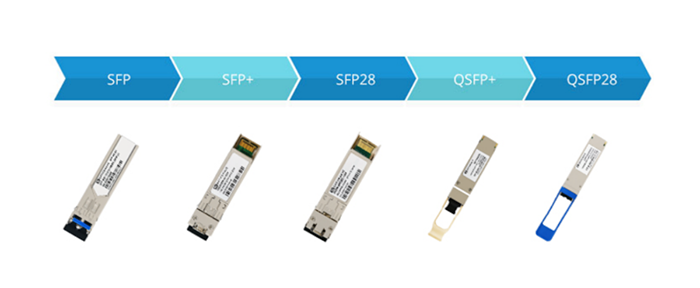
Are all transceivers used to connect switches or other network equipment to copper or fiber optic cables? They are most commonly used to add fiber optic ports. Selecting the right connector is essential to build a network that functions correctly at an efficient price point. There are five form factors: SFP, SFP+, SFP28, QSFP+, and QSFP28. They are different optical transceiver types, but all are hot-pluggable network interface modules that connect a network switch and other networking devices (such as a server or media converter) for data transmission. Which SFP transceiver you choose depends on the cable type, application, optical range required for your network, and desired data transfer rate. They are substantially more popular than the rest of the fiber connectivity world.
Then, what is the difference between SFP vs. SFP+, SFP28 vs. SFP+, QSFP vs. QSFP28? Is QSFP28 compatible with QSFP+? Can I use SFP28 transceivers in SFP+ ports? How to choose between these five form factors? This article will explain.
What is the SFP Transceiver?
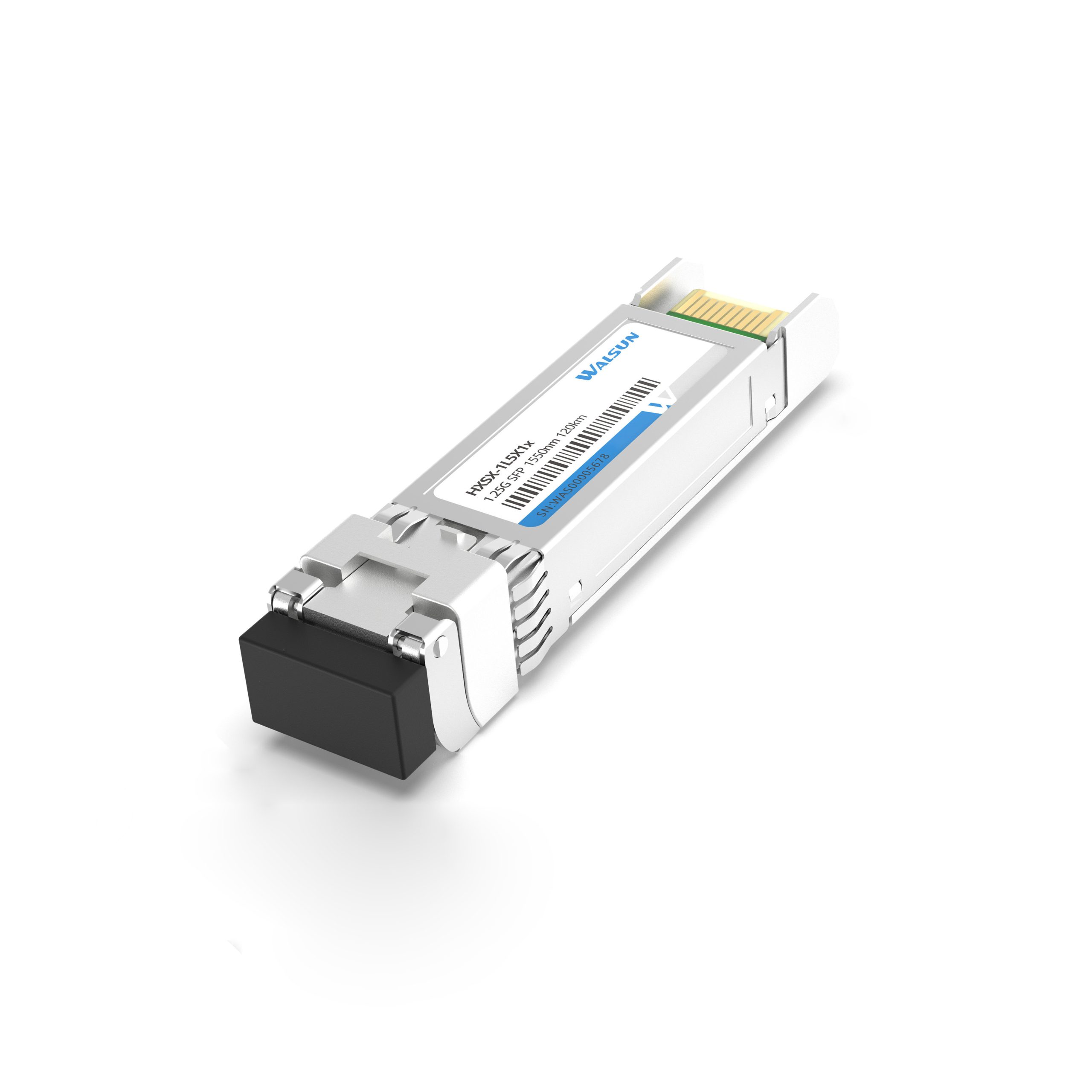
SFP stands for Small Form Pluggable. It is also known as a “mini GBIC” (Gigabit Interface Converter). The SFP transceiver is a tiny transceiver that connects fiber optic cables to various network devices such as switches, routers, network cards, and wireless access points. Depending on the data rate and application, a variety of SFP transceivers are available, including 155M SFP, 622M SFP, 1G SFP, 2.5G SFP, 2G/4G Fiber Channel SFP, 3G SFP, and 6G SFP. They are used in fiber optic Ethernet networks and are especially common in business networks. SFP transceivers are among the most widely used fiber optic networking devices today.
What is the SFP+ Transceiver?
Compared to SFP transceivers, SFP+ transceivers are a more advanced version of this technology. SFP+ transceivers are typically offered at 8Gbps, 10Gbps, or 16Gbps. They have the same dimensions as SFPs, so it is easy to integrate them into existing infrastructures. SFP+ transceivers are one of the most popular data center cabling applications.
According to the application, SFP+ transceivers can be divided into five categories: Dual-fiber SFP+, Bidi SFP+, Copper SFP+, CWDM SFP+, and DWDM SFP+.
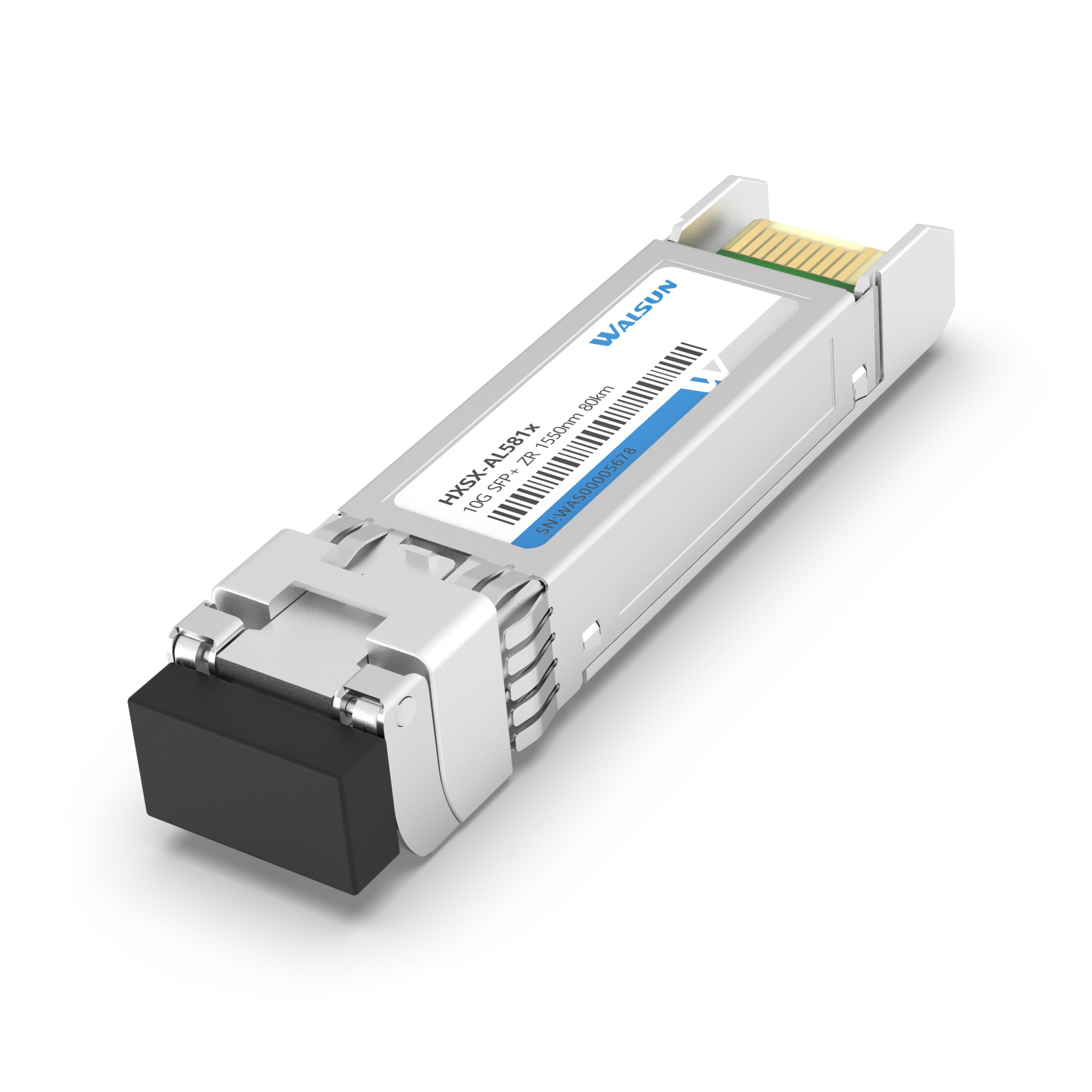
What is the SFP28 Transceiver?
SFP28 stands for Small Form-Factor Pluggable 28. It is a third-generation SFP connection system built for 25G throughput per IEEE 802.3 by specification (25GBASE-CR). SFP28 is an improved version of SFP+, designed for 25G signal transmission. SFP28 has the same type of form factor as SFP+, but it provides an electrical connection of 25Gbps per lane. Compared with SFP+, SFP28 provides higher bandwidth capabilities.
According to the application, SFP28 transceivers can be divided into six categories: dual fiber SFP28, Bidi SFP28, CWDM SFP28, DWDM SFP28, SFP28 DAC, and SFP28 AOC.
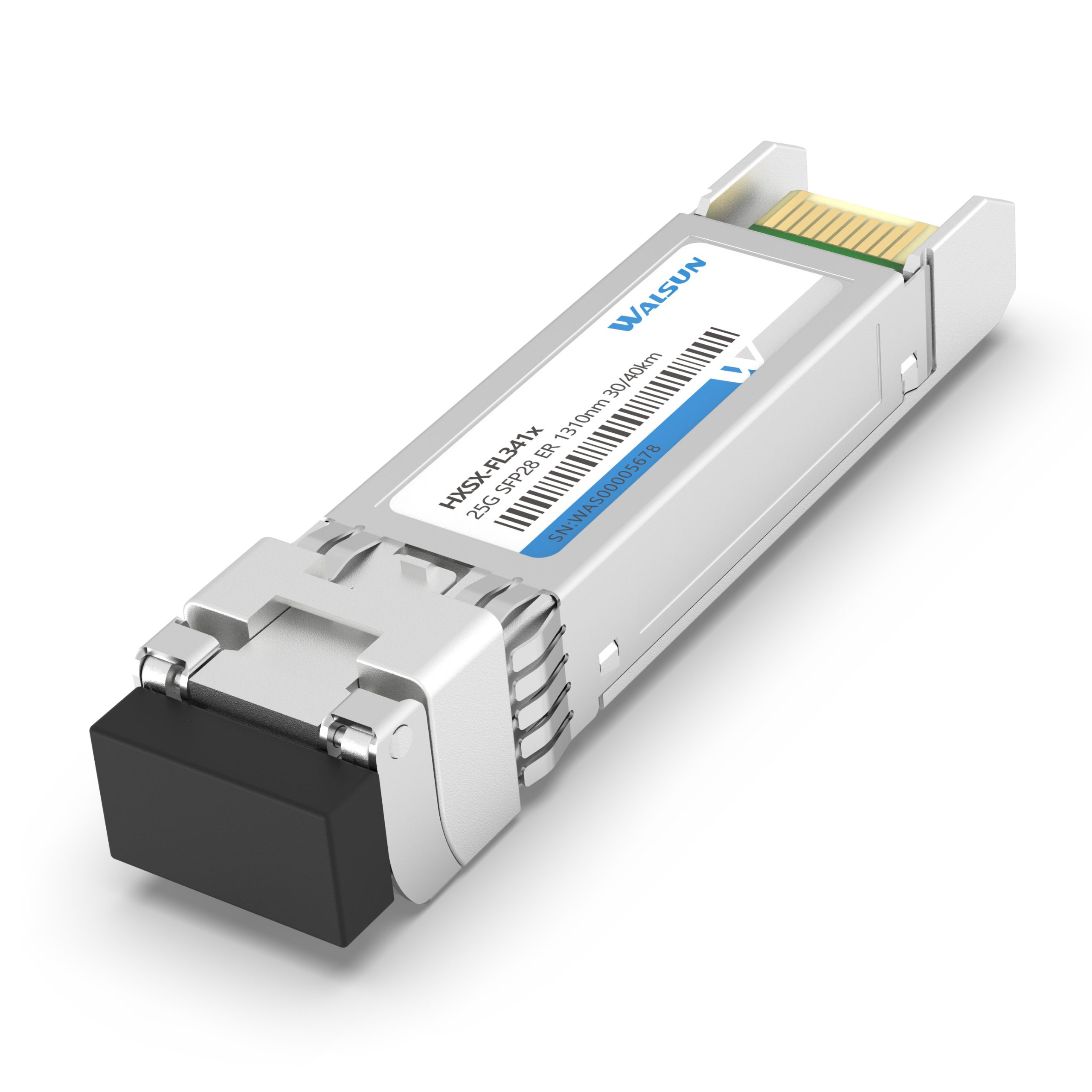
What is the QSFP+ Transceiver?
QSFP+, commonly called QSFP, is an abbreviation for Quad (4 lanes) Small Form-Factor Pluggable. QSFP+ optics are another miniature hot-swappable transceiver for data transmission. Compared to SFP+, QSFP+ supports 4x10G or 4x14G SFP+ data rate for higher bandwidth capability. It offers multiple data rate options for Ethernet, Fiber Channel, InfiniBand, and SONET/SDH technologies.
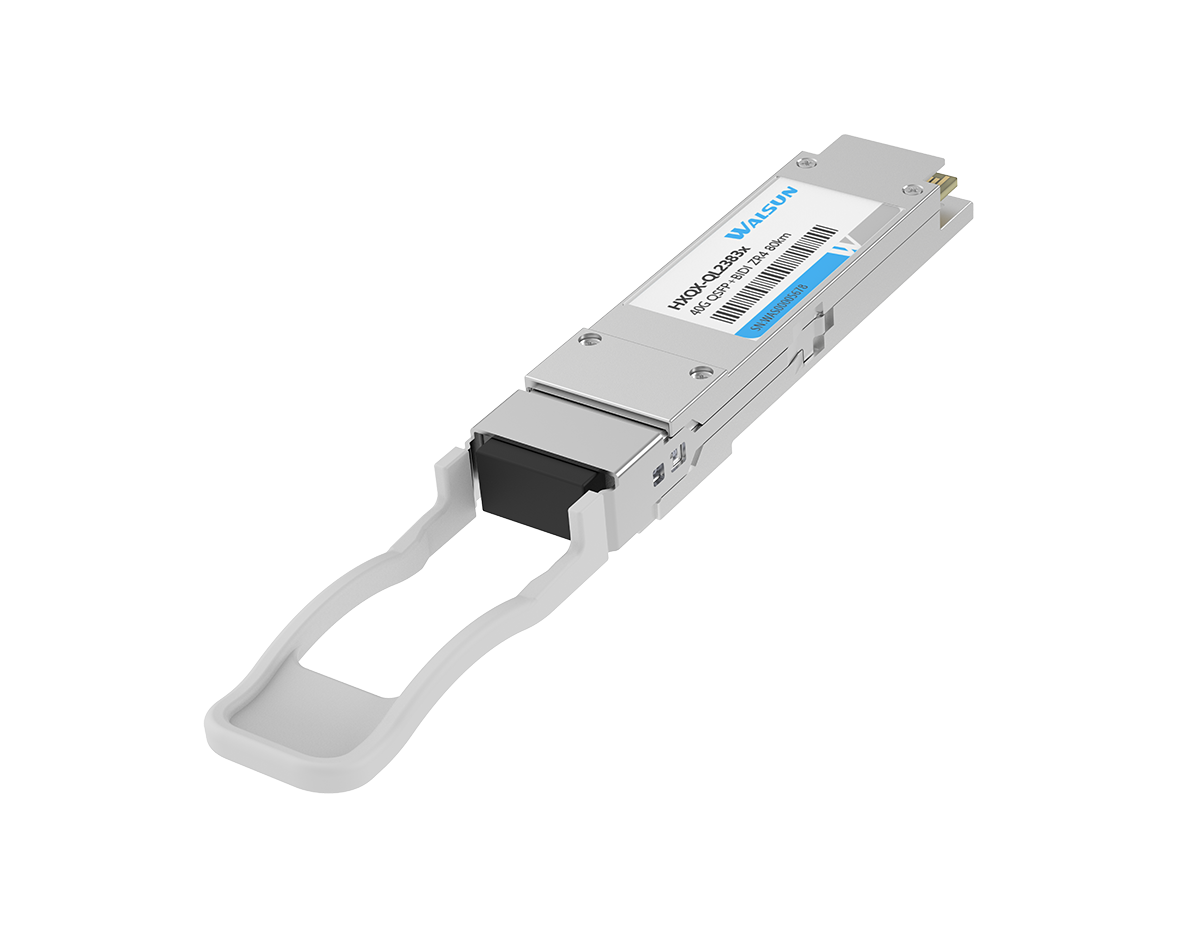
What is the QSFP28 Transceiver?
QSFP28 is an abbreviation for Quad Small Form-Factor Pluggable 28. QSFP28 transceivers are suitable for 100 Gigabit Ethernet, EDR InfiniBand, or 32G Fiber Channel networks. The QSFP28 100G transceiver features four high-speed differential signaling lanes with data rates ranging from 25 Gbps to 40 Gbps. In the 100G optical market, QSFP28 transceivers are more popular than CFP, CFP2, and CFP4 form factors.
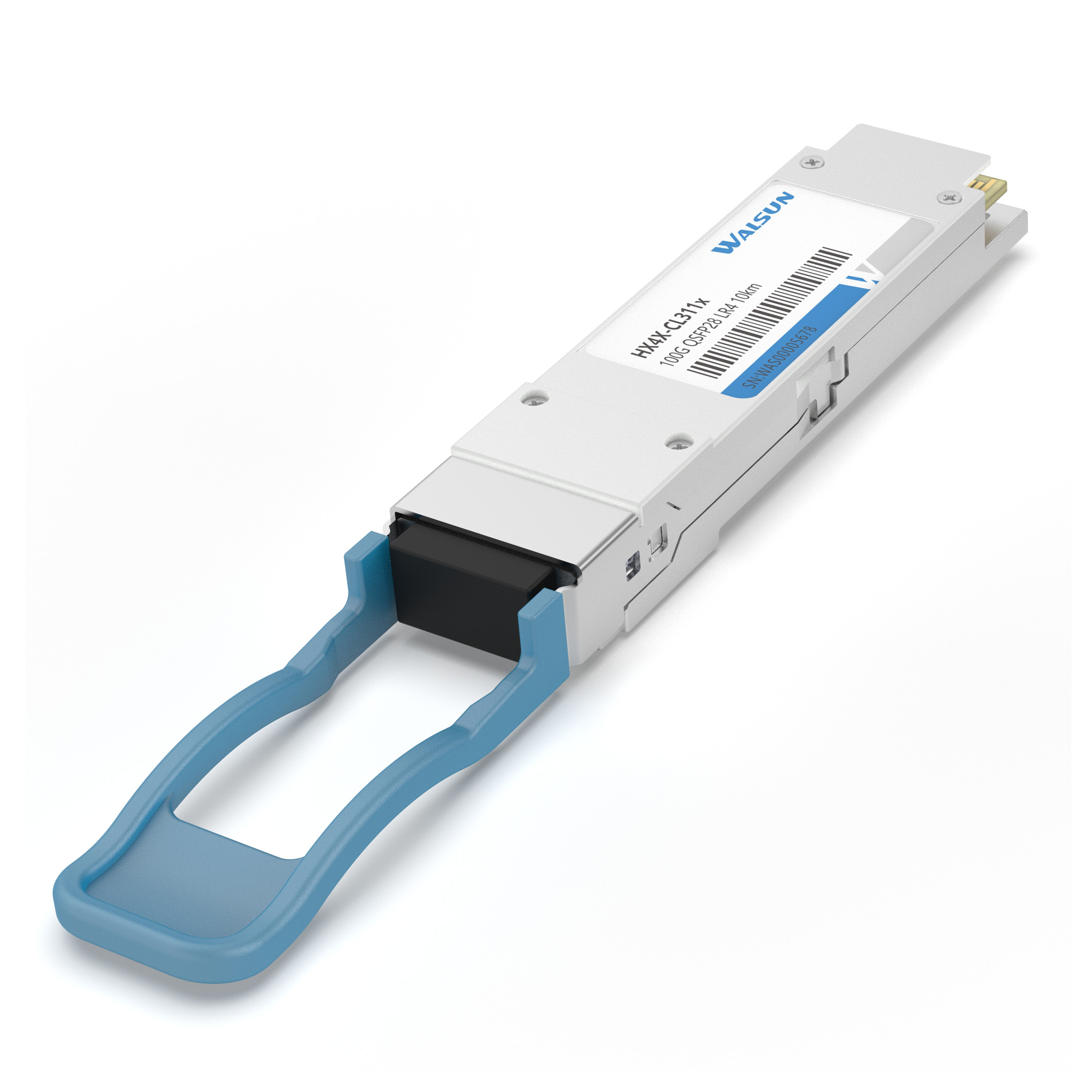
Comparisons in SFP vs SFP+ vs SFP28 vs QSFP+ vs QSFP28
After figuring out what SFP/SFP+/SFP28/QSFP+/QSFP28 are, the following part will give detailed comparisons of SFP vs SFP+, SFP28 vs SFP+, QSFP vs QSFP28 and SFP28 vs QSFP28.
| Optic Types | Standard | Data Rate | Wavelength | Fiber Type | Max Distance | Typical Connector | DOM | OperatingTemperature |
|---|---|---|---|---|---|---|---|---|
| SFP | SFP | 155Mbps 1.25Gbps 2.5Gbps 3Gbps |
850nm 1310nm 1550nm CWDM DWDM BiDi |
MMF SMF |
160KM | LCRJ-45 | No or Yes | Commercial Industrial |
| SFP+ | SFP+ MSA |
6G 8G 10G |
850nm 1310nm 1550nm CWDM DWDM BiDi |
MMF SMF |
120KM | LCRJ-45 | Yes | Commercial Industrial |
| SFP28 | IEEE 802.3by SFP28 MSA SFF- 8472 SFF- 8432 |
25G 32G |
850nm 1310nm CWDM DWDM BiDi |
MMF SMF |
10KM | LC | Yes | Commercial Industrial |
| QSFP+ | IEEE 802.3ba QSFP+ MSA SFF- 8436 SFF- 8636 Infiniband 40G QDR |
40G 56G |
850nm 1310nm 832- 918nm |
MMF SMF |
40KM | LC MPO/MTP |
Yes | Commercial Industrial |
| QSFP28 | IEEE 802.3bm QSFP28 MSA SFF- 8665 SFF- 8636 |
100G | 850nm 1310nm |
MMF SMF |
80KM | LC MPO/MTP |
Yes | Commercial Industrial |
SFP vs SFP+
Same size but with different speeds and compatibility. SFP+ is used for 10-Gigabit Ethernet applications, while SFP is used for 100BASE or 1000BASE applications. SFP complies with IEEE802.3 and SFF-8472 standards, while SFP+ is based on SFF-8431. SFP+ ports can accept SFP optics, but the speed is reduced to 1 Gbit/s. SFP+ transceivers cannot be plugged into SFP ports, otherwise, the product or the port may be damaged. Generally, SFP+ is more expensive than SFP.
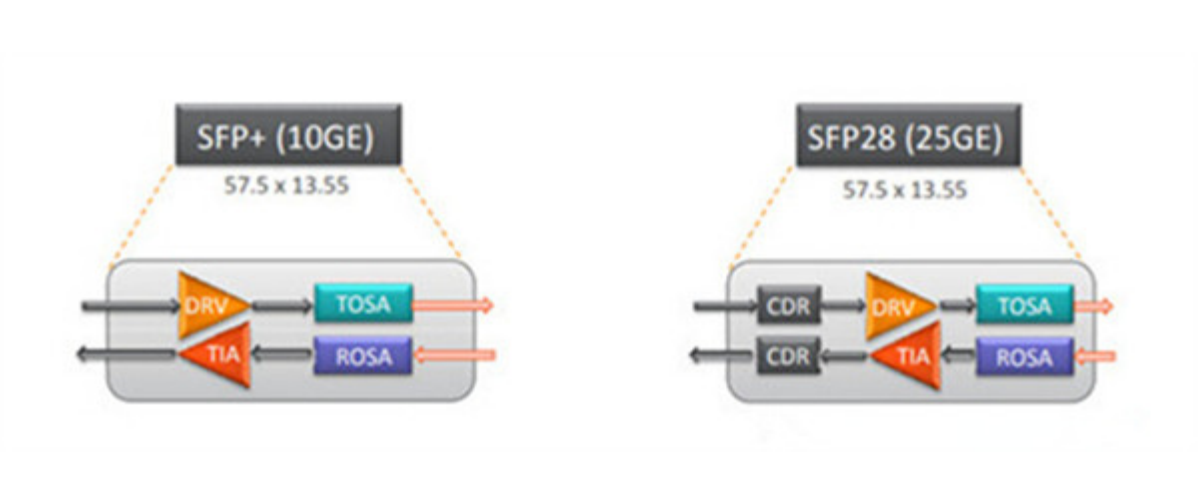
SFP+ vs SFP28
SFP+ is primarily associated with 10G connections, while SFP28 is generally associated with 25G connections. They share the same form factor and the pinouts of the SFP28 and SFP+ connectors are mating compatible. So SFP28 will work with SFP+ optics but at a reduced speed of 10 Gbit/s. If the port can be set to 10G transmission, the SFP+ module will work well with the SFP28 port on the network switch, otherwise, the SFP+ module will not work.
SFP+ vs QSFP+
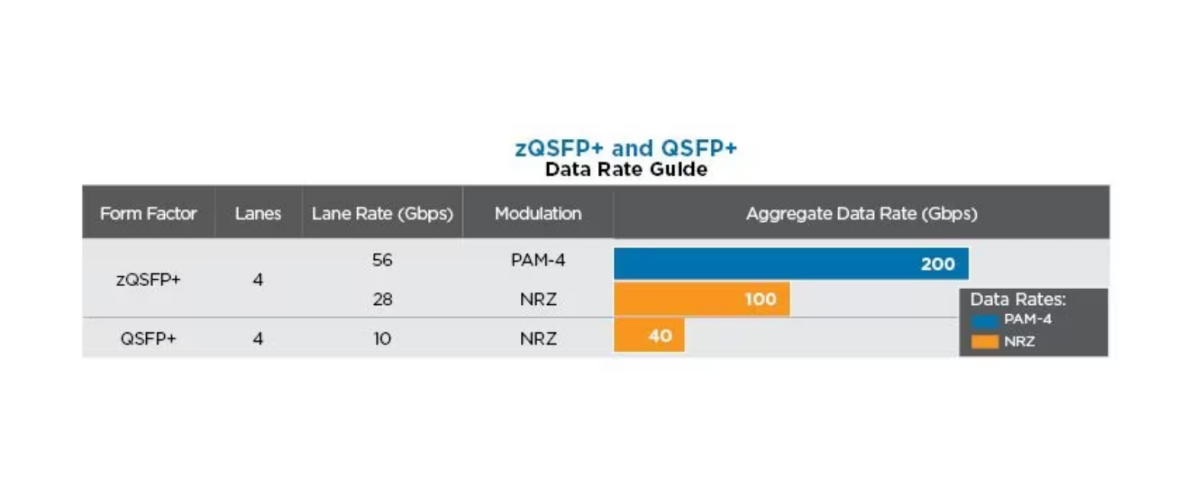
The primary difference between QSFP and SFP is the quad form. QSFP+ is an evolution of QSFP to support four 10 Gbit/s channels carrying 10-Gigabit Ethernet, 10G Fiber Channel, or InfiniBand, which allows for 4X10G cables and stackable networking designs that achieve better throughput. QSFP+ can replace 4 standard SFP+ transceivers, enabling higher port density and overall system cost savings than SFP+.
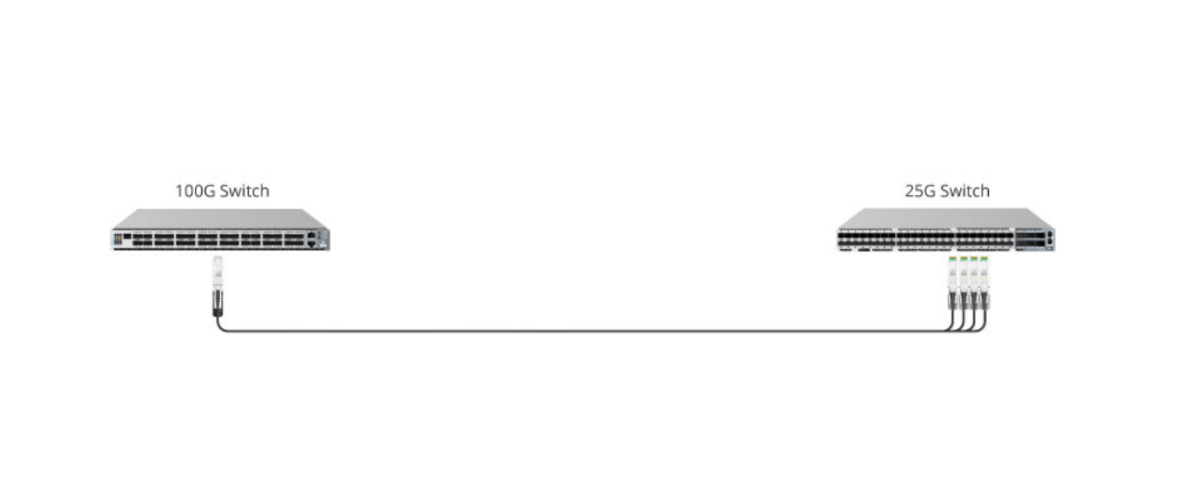
SFP28 vs QSFP28
SFP28 and QSFP28 transceivers use different sizes and operating principles. SFP28 supports only one 25 Gbit/s lane, while QSFP28 supports 4 independent lanes, each at 25 Gbit/s. Both can be used in a 100G network, but SFP28 is used in the SFP28 distribution scheme as QSFP28.
QSFP+ vs QSFP28:
QSFP+ and QSFP28 transceivers integrate 4 transmit channels and 4 receive channels of the same size. In addition, both QSFP+ and QSFP28 product series include transceiver modules and DAC/AOC cables, but the speed differs. QSFP+ modules support 1x 40 Gbit/s and QSFP+ DAC/AOC cables support 4x 10 Gbit/s. QSFP28 modules are capable of transmitting data at 100 Gbit/s, and QSFP28 DAC/AOC cables can operate at 4x 25 Gbit/s or 2x 50 Gbit/s. Note that generally, QSFP28 modules cannot break through 10G links. But if the switch supports it, inserting a QSFP+ module into a QSFP28 port is another case. In this case, QSFP28 can break out to 4x10G like QSFP+ transceiver modules.
How to Choosing the right transceivers
To help you make an informed choice, we have listed key parameters to consider when choosing an optical transceiver:
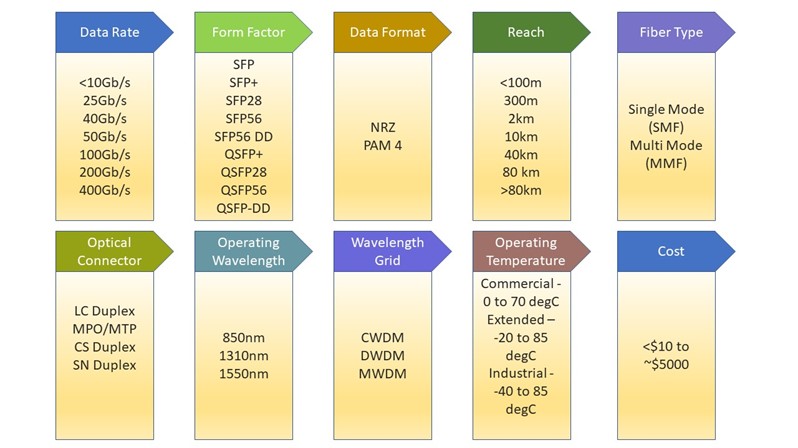
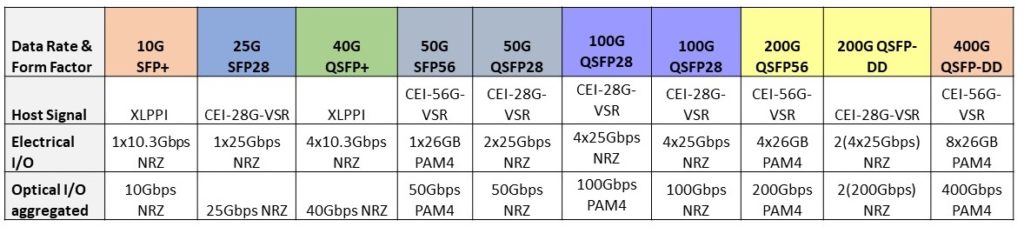
Data Rate and Form Factor: The multi-source agreement (MSA) defines the different transceiver form factors. Popular form factors include SFP+, SFP28, QSFP+, QSFP28, QSFP56 and so on. Different switching equipment support different data rates and data formats. Always ensure that your transceiver is compatible with your network switch.
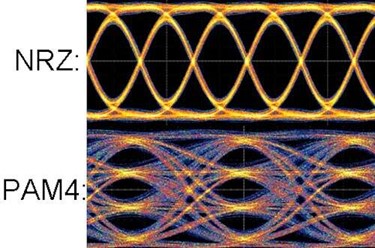
Data Format : NRZ is the preferred encoding scheme for 28 Gbps rates. PAM4 has become the standard for medium and long distance data transmission where each link transmits 50 to 56 Gbps per lane.
The image below shows the difference in eye between NRZ and PAM4 modulation.
The image below gives a breakdown of transceiver by data rate, form factor and data format.
Reach and Fiber Type: A singular advantage of fiber over copper is the distance a signal can be transmitted over fiber. The reach also defines the type of fiber to be used, with multi-mode being used for shorter reaches and single mode for long reaches.
Connectors: The most common types of fiber cable connectors used in optical transceivers and networks are LC and MPO/MTP though there are some new types of connectors available now.
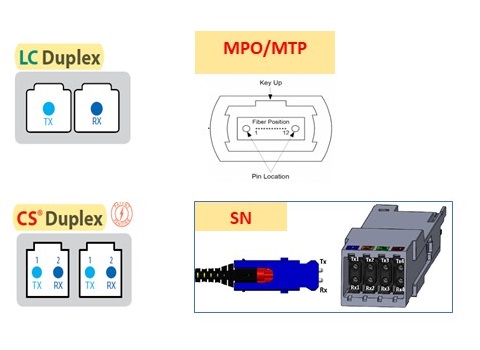
LC duplex: This is a connector that everyone is familiar with. LC duplex is widely used in 40G and 100G transceivers.
MPO/MTP Connectors: These can be 8/12/24 fiber and are most commonly used in 40G, 100G and 400G transceivers.
CS Duplex: CS is a new connector type typically used in 200G and 400G transceiver connections. The reduced size allows double the density in patch panels compared to a LC connector.
SN connector: This is designed primarily for OSFP/QSFP-DD and allows four duplex connections in a QSFP-DD/OSFP without using a separate fan-out.
Operating Wavelengths: 850nm, 1310nm and 1550nm are the prime wavelengths used in fiber optics transmission.
850nm : Typically used in short distance multi-mode fiber connections below 500m.
1310nm : Used in Single Mode, generally used for transmission for high data rate transmission.
1550nm : Used in single mode long reach links at data rates below 10Gbps because of its low attenuation. Beyond 10Gbps modulation, 1550nm is hardly used due to its’ unacceptably high fiber dispersion. For higher speed modulations, 1310nm is the wavelength of choice for 40km and 80km links.
Wavelength grids: WDM (Wavelength Division Multiplexing) technology allows for transmission of multiple wavelengths over one fiber using different wavelengths.
CWDM : CWDM (Coarse Wavelength Division Multiplexing) fiber transceivers support wavelengths ranging from 1270nm to 1610nm with a spacing of exactly 20nm. Each channel uses a different color.
DWDM : DWDM (Dense Wavelength Division Multiplexing) can accommodate 40, 80 or even 160 wavelengths with narrower wavelength spans which are as small as 0.8nm, 0.4nm or even 0.2nm.
MWDM: MWDM (Medium Wavelength Division Multiplexing) used in 5G networks is relatively new technology. It is based on the 6 wavelengths of CWDM, shifted by 3.5nm left and right to expand to 12 wavelengths (1267.5, 1274.5, 1287.5, 1294.5, 1307.5, 1314.5, 1327.5, 1334.5, 1347.5, 1354.5, 1367.5, 1374.5nm).
Operating Temperature Range : Standard operating voltage of an optical transceiver is 3.3V. Most applications need only commercial temperature transceivers at 0 to 70 degC. Vitex also offers extended ( -20 to 85degC) and industrial temperature (-40 to 85 degC) transceivers for outdoor and rugged applications.
Cost: Cost is a critical factor in transceiver selection. Low data rate transceivers can cost under $20, while you end up paying a few thousands for a 100G or 400G transceiver.