Fiber loopback is a crucial testing device in optical networking that enables technicians to validate the performance and integrity of optical links. In this blog post, we will explore the significance of fiber loopback and its role in ensuring a reliable and efficient optical network. Whether you are new to optical networking or a seasoned professional, understanding fiber loopback is essential for successful installation, maintenance, and troubleshooting processes.
What is Fiber Loopback? And the Importance of Fiber Loopback
Fiber optic loopback (loopback plug or loopback adapter), is a plug used to test physical ports to identify network problems. It provides a simple and effective method for testing the transmission capability and receiving sensitivity of network equipment. It is a connection device with a number of different ports that loopback plugs can be plugged into for loopback testing, including serial ports, Ethernet ports, and WAN connections.
Fiber Loopback plays a vital role in the testing and verification of optical networks. By creating a loop in the network, it allows the transmitted signal to be sent back to the originating device for evaluation. This capability is invaluable during network installation, as it helps identify potential issues and ensures that the optical link is functioning as intended. Moreover, during maintenance and troubleshooting, fiber Loopback aids in isolating faulty components, saving valuable time and resources. Its ability to simulate real traffic conditions allows technicians to assess the network’s performance accurately. Without proper testing using fiber Loopback, the integrity, and reliability of the optical network may be compromised.
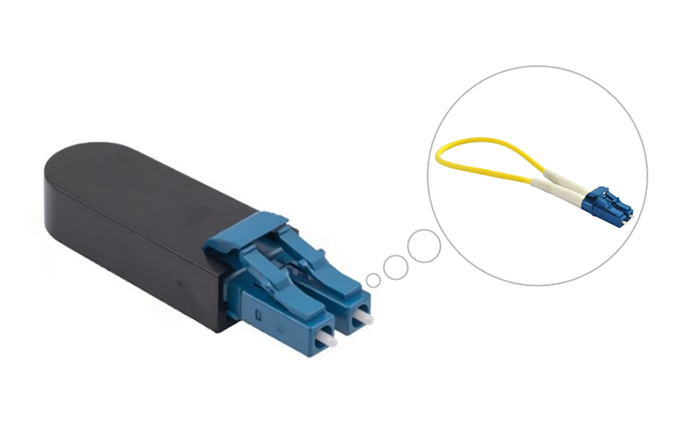
Fiber Loopback Types and Configurations
Typically, fiber optic loopbacks are simplex fiber optic cables terminated with two connectors at each end, forming a loop. The black housing is used to protect the optical cable, which makes the design more compact and more robust to use. Depending on the type of fiber used, there are singlemode loopbacks and multimode loopbacks available with different polish types. According to the type of optical connector for loopback, fiber optic loopback cables can be divided into MTP/MPO, LC, SC, FC, ST & E2000, etc. When testing fiber optic transceiver modules, LC, SC, and MTP/MPO loopback cables are most commonly used.
(1) LC, SC Fiber Optic Loopback
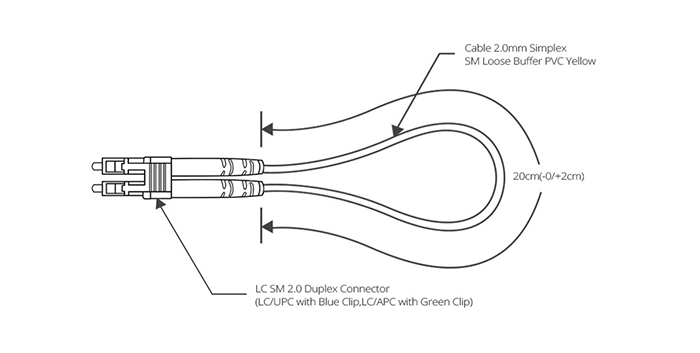
LC and SC Fiber Optic Loopbacks use simplex cables and common connectors, and understanding their configuration is not difficult. A fiber optic loopback consists of two fiber optic connectors that plug into the output and input ports of the device. Push-pull design for easy insertion and extraction for testing 10G or 40G or 100G interface transceivers. Specifically designed for troubleshooting network fault nodes.
Take the LC Fiber Optic Loopback cable as an example, is one of the most popular cables. It supports the test of transceivers featuring LC interfaces. They feature low insertion loss, low back reflection, and high-precision alignment to conform to RJ-45 style connectors.
(2) MPO Fiber Optic Loopback
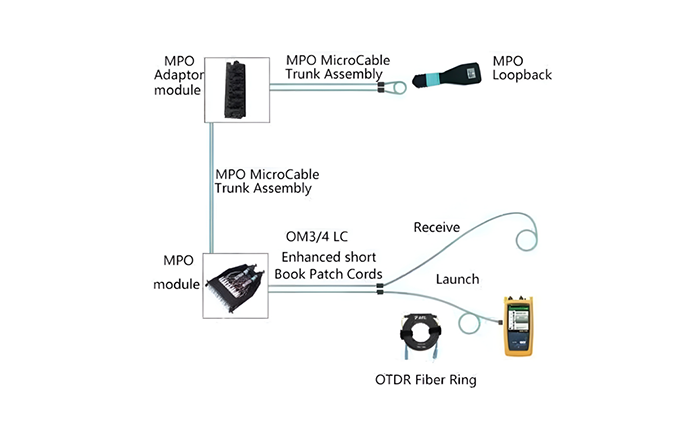
MPO Fiber Optic Loopback, put both ends of the optical fiber into an MPO connector, so that the optical path is in the same connector, without changing the signal or repeating the signal back to itself. It is mainly used to test parallel optical devices, which can provide an effective solution to test the transmitting ability and receiving sensitivity of network equipment. Especially in 40/100G network communication, various potential phenomena can be located through the return signal, so as to achieve effective testing and evaluation of single components or interfaces on the paired optical fiber network and the network. Since the number of fibers in different applications is not always the same, their configurations vary.
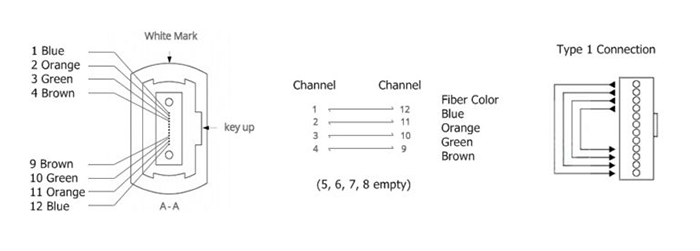
① 8 Core MTP/MPO Fiber Loopback Configuration
In an 8-fiber MTP/MPO loopback, eight fibers are arranged on either side of the connector, and the 8-fiber loopback polarity channels are aligned, leaving the middle four channels empty. The optical fiber adopts the straight structure of 1-12, 2-11, 5-8, 6-7. The polarity channel arrangement is shown in the figure below.
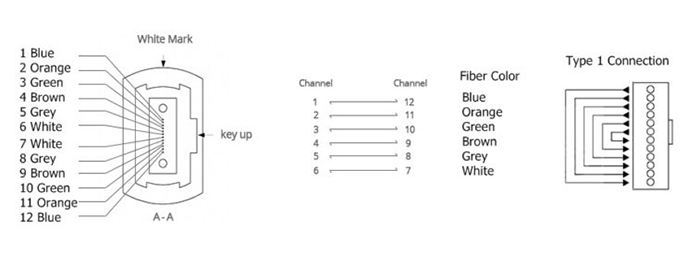
② 12 Core MTP/MPO Fiber Loopback Configuration
The only difference between the 12-core MTP/MPO loopback and the 8-core MTP/MPO loopback is that the central four channels are not empty. Its alignment is 1-12, 2-11, 3-10, 4-9, 5-8, 6-7.
③ 24 Core MTP/MPO Fiber Loopback Configuration
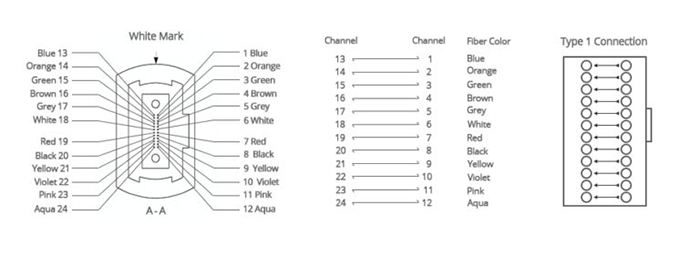
The 24-fiber MTP loopback also adopts type 1 polarity. 24 Fiber Loopback Polarity Channel Alignment:
Advantages and Limitations of Fiber Loopback
Fiber loopback offers numerous advantages in testing optical networks. One of its primary benefits is its ability to provide an end-to-end testing scenario, simulating real traffic conditions and allowing comprehensive assessments of network performance. Additionally, fiber loopback devices are relatively easy to use and require minimal configuration, enabling quick and efficient testing processes.
However, like any testing method, fiber loopback also has limitations. It may not be suitable for identifying certain network impairments or issues that occur only under specific traffic patterns or environmental conditions. As a result, it is essential to complement fiber loopback testing with other methods such as optical time-domain reflectometry (OTDR) and bit-error-rate testing (BERT) for a comprehensive evaluation of the optical network’s health.
Common Faults and Avoidance Methods of Fiber Optic Loopback
Fiber loopback testing is a method used to test the integrity and performance of fiber optic network equipment and connections. It involves connecting a loopback plug or module to the fiber optic port, creating a loop in the link, and then sending and receiving test signals to check for any faults. Common faults that can occur during fiber loopback testing include:
(1) The End Face is Dirty
It is mainly caused by the premature removal of the dust cap before docking or prolonged exposure to an unclean environment. Such dirt will directly affect the docking performance of the product, making the effect unstable after docking, and even causing damage to the opposite joint during docking.
Solution: If there is foreseeable contamination on the end surface, try to use special cleaning tools or dust-free paper soaked in absolute ethanol for cleaning. Do not use paper towels, cotton wool, ordinary cotton swabs, and other items to clean the end surface.
(2) Mechanical Damage to Parts
It is mainly caused by the excessive application of external force during the construction process. This type of damage may not affect the performance in the initial stage, but it will basically fail completely in the short term.
Solution: When connecting the connector, confirm the direction of the connector positioning key and insert the adapter or socket panel axially, and do not repeatedly insert and pull out when the end face cannot be viewed. When the MPO connector is inserted into the adapter, pay attention to holding the tail sleeve of the connector, and hold the housing of the connector when pulling it out.
(3) Bend Loss
Excessive bending of the fiber can cause signal attenuation.
Solution: When bending the cable, keep the bending radius equal to or greater than 20 times the outer diameter of the cable. Do not drag or push the cable vigorously to prevent scratches that may cause the cable to break or break.
(4) Calibration and Verification
Higher-than-expected insertion loss can be indicative of a faulty connector or cable. And poor return loss could indicate an issue with the connector’s end-face or mismatched connectors.
Solution: Regularly calibrate and verify the loopback equipment to maintain accuracy in the test results.