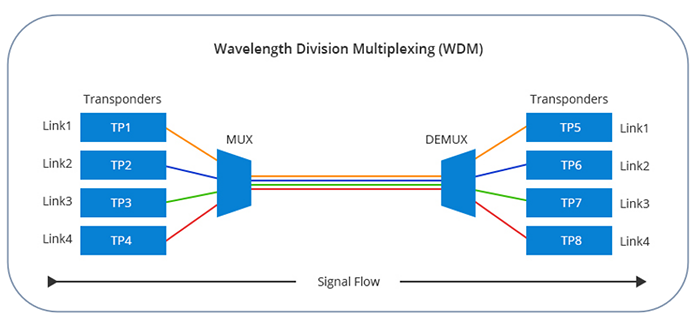
Wavelength Division Multiplexing (WDM), is a technology for transmitting different wavelengths over a single optical fiber. The system uses a multiplexer at the transmitting end to combine multiple signals with each other and a demultiplexer at the receiving end to separate the signals. According to different channel spaces, there are two main types of WDM technologies, one is DWDM (Dense Wavelength Division Multiplexing) and the other is CWDM (Coarse Wavelength Division Multiplexing). WDM makes two-way communication possible, greatly saving the cost of optical fiber.
What is CWDM?
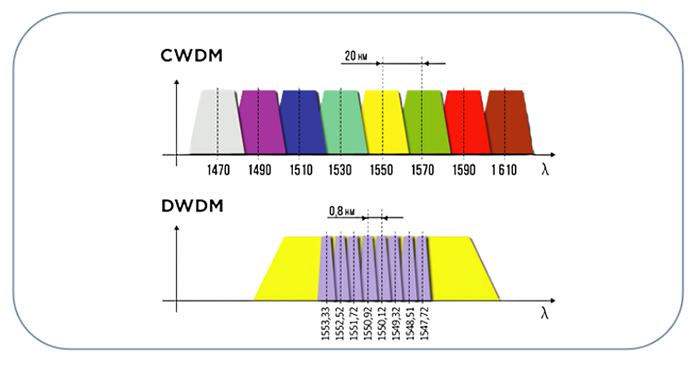
CWDM is designed for short-distance communication, using a wide range of frequencies with a spread of wavelengths. Since CWDM is based on 20 nm channel spacing from 1470 to 1610 nm, it is typically deployed over fiber spans of up to 80 km or less because optical amplifiers cannot be used with widely spaced channels. This wide spacing of channels allows the use of affordable optics. However, the link capacity and supported distance of CWDM is smaller than DWDM. Typically used in short-reach networks such as campus networks and metropolitan area networks (MANs).
For example, T1 on 1570nm fiber can be transported with 10Gbps Ethernet at 1590nm. By using CWDM optics, it is possible to increase the bandwidth of existing fiber infrastructure and alleviate fiber depletion. CWDM optics are available in various configurations such as 4-, 8-, or 16-channel mux/demux modules as well as add/drop modules.
What is DWDM?
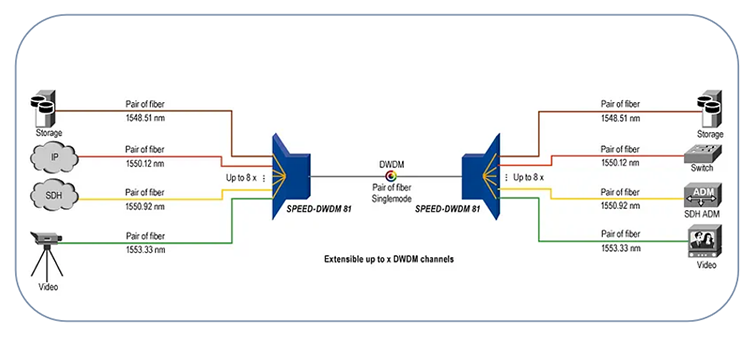
DWDM is designed to increase the bandwidth of existing fiber optic networks. It allows data signals from multiple sources to be combined over a pair of optical fibers while keeping the data streams completely independent. DWDM uses tighter wavelength spacing to accommodate more channels on a single optical fiber. This technique is particularly effective for systems with more than eight active wavelengths per fiber, as it maximizes the available optical bandwidth. Typically used in long-distance networks, such as long-distance and submarine networks.
What’s the Difference Between CWDM and DWDM?
(1) Channel Pitch
CWDM has a wider pitch than DWDM. It is capable of transmitting up to 18 CWDM wavelengths in a spectral grid from 1271nm to 1611nm with a channel spacing of 20nm.
DWDM can carry 40, 80, or up to 160 wavelengths at a narrower pitch of 0.8/0.4nm (100 GHz/50 GHz grid). Its wavelength is 1525nm to 1565nm (C band) and 1570nm to 1610nm (L band).
(2) Transmission Distance
Since DWDM wavelengths are highly integrated with optical fibers during optical transmission, DWDM can reach farther distances than CWDM. Unlike DWDM systems, CWDM cannot transmit over infinite distances. The maximum coverage of CWDM is about 160 kilometers. Amplified DWDM systems can go even further.
(3) Modulating the Laser
CWDM systems use uncooled lasers, while DWDM systems use cooled lasers. Cooled lasers are temperature-tuned to ensure better performance, higher safety, and a longer lifetime of the DWDM system. But it also consumes more power than the electronically tuned uncooled lasers used in CWDM systems.
(4) Cost
The use of cooled laser technology increases the cost of DWDM systems because temperature tuning is difficult to achieve due to the uneven temperature distribution over a wide wavelength range. Additionally, DWDM equipment is typically four to five times more expensive than CWDM systems. However, due to the popularity of DWDM, the price of DWDM transceivers is about 20-25% lower than that of CWDM transceivers.
Pros and Cons of CWDM & DWDM
(1) CWDM Pros and Cons:
Lower power consumption; Smaller space requirements; Can use SMF fiber or MMF cable; LED or laser can be used as power supply; Larger individual payload per channel; Smaller, cheaper filters; Save on startup and scaling costs.
Lower capacity than DWDM; Less range; Regeneration and amplification; O, A and M functions are not carrier-grade.
(2) DWDM Pros and Cons:
Maximum capacity system available; Maximum distance capability of EDFA; Can reduce repeater “amp” sites; Pay as you expand; Develop mature O, A, M systems.
Requires more space; Requires more power; Requires high-precision lasers and filters; Expensive EDFAs for amplifiers; Start-up costs are higher than equivalent CWDM systems.
CWDM and DWDM Application Scenarios
CWDM: Metropolitan area network access layer, telecommunications, enterprise network, campus network, etc.
DWDM: Long-distance, high-capacity long-distance trunk networks, or ultra-large-capacity metropolitan area network core node.
Mini Version of CWDM——CCWDM
(1) What is CCWDM?
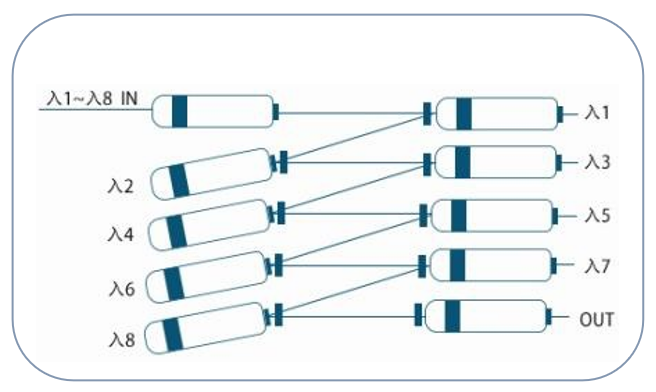
CCWDM is called a compact coarse wavelength division multiplexer, which is a mini version of CWDM. It is based on TFF (Thin Film Filter) wavelength division multiplexing technology, and works in the same way as CWDM, except that the adjacent channels of CCWDM use parallel beams to cascade in free space instead of optical fibers. Without the optical fiber used for cascading, the size of the CCWDM package is 10 times smaller than the standard CWDM package.
(2) CWDM Vs. CCWDM
The CWDM system uses a low-cost, unrefrigerated distributed feedback (DFB) laser, while the CCWDM has its collimator and filter welded on a common substrate, and the cascade structure of the two is different.
A three-port filter for a specific wavelength in CWDM, whose wavelength channel consists of two lenses and a TFF matched to that specific wavelength. The reflection port of each filter is connected to the common port of the next filter, and the filters are connected through optical fiber connectors, which is a CWDM multiplexer.
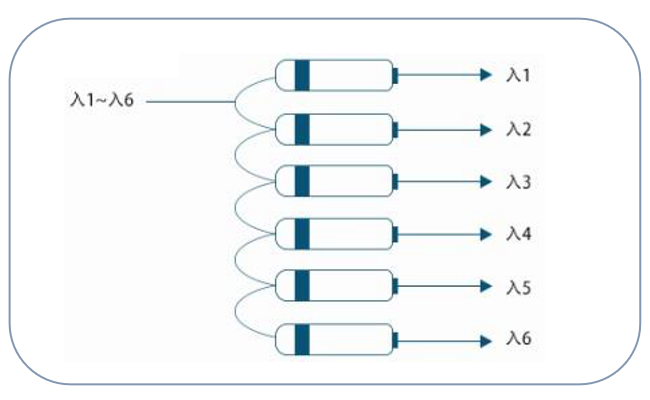
The principle of CCWDM is to use the input lens to focus the optical signals with wavelengths λ1, λ2…λn on the input fiber to the first filter; the optical signal with wavelength λ1 passes through the first filter and is coupled to the first output lens. In the first output fiber, the optical signal with a wavelength of λ1 is separated; the remaining optical signals are reflected from the first slide to the next slide for optical signal separation; and so on until all signals are separated. Coupling between wavelength channels is achieved in the form of straight rays that follow a zigzag route.
Conclusion
The best choice of CWDM or DWDM will depend on the specific requirements of the network. If you need to increase the capacity of a short-range network, then CWDM may be a good option. If you need to increase the capacity of a long-range network, then DWDM may be a better option.