With the continuous development of modern information technology, the demand for information transmission channel capacity by users is also rapidly increasing. Therefore, the market demand for 100G optical modulesis constantly increasing, and their proportion in network construction costs is gradually increasing. The mainstream packaging of 100G optical modules mainly includes CFP, CFP2, CFP4, CFP8, QSFP28, and other forms. QSFP28 packaging has become the mainstream packaging form for 100G optical modules due to its advantages of smaller size and lower power consumption.
The QSFP28 optical module standards are mainly divided into SR4, BIDI SR, PSM4, LR4, ER4, ZR4, etc. In this blog, Walsun will introduce you to the 100G QSFP28 BIDI SR optical module.
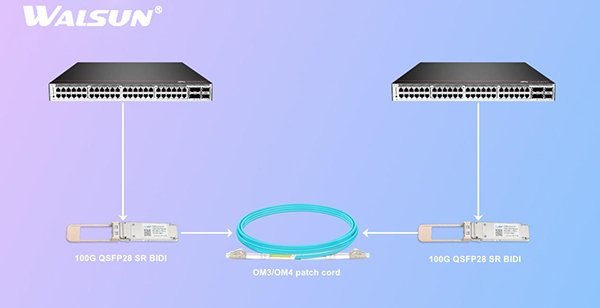
The 100G QSFP28 SR BIDI optical module has two independent full duplex optical channels, which comply with QSFP28 MSA and RoHS standards. The maximum power consumption is 4W, and the operating temperature is 0 to 70°C. When used with OM3 fiber patch cords, it can transmit up to 70 meters, and when used with OM4 fiber patch cords, it can transmit up to 100 meters.
Working principle
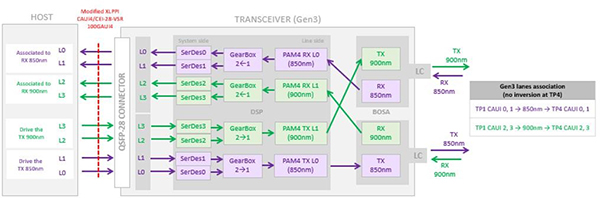
The 100G QSFP28 SR BIDI optical module utilizes PAM4 technology to enable each LC port to simultaneously transmit and receive optical signals of different wavelengths from a multimode fiber. Therefore, BIDI optical modules must be used in pairs to achieve bidirectional data transmission. The 100G QSFP28 SR BIDI optical module uses a single fiber to transmit and receive at a 50G rate, and two interfaces work together to achieve 100G transmission. It is suitable for short distance data communication and interconnection applications using multimode fiber (MMF). The working principle is as follows:
Product advantages and application
Because the network requirements have been upgraded from the original 10G or 25G to 100G, and the 10G or 25G network wiring is mainly based on LC duplex multimode fiber. If the conventional 100G QSFP28 SR4 optical modulerequires the use of MPO 8-core or 12-core multimode fiber, significant adjustments will be made on the basis of the original wiring, resulting in extremely high costs. The 100G BIDI SR optical module satisfies 100G transmission through two multimode fibers, which can effectively save on the cost of fiber infrastructure and is widely used in the fields of telecommunications and data centers.
That’s all the content of this blog! For more product information, welcome to visit our website! Thank you for your support!
Related Article:
What Is the Introduction of the Cisco C9500 Switch and Optical Module Solutions
What Are the Introduction and Applications of 32G SFP28 FC Single-Mode Optical Modules
What Is the H3C Equipment Internet Cafe 10G Optical Module Solution
How to Interconnect a Gigabit RJ45 Port with an SFP Optical Port Using a Copper-T Module
Where to Use 100G QSFP28 Optical Modules in Data Centers