The Fibre Channel switch originated from the Fibre Channel protocol. On the fourth layer of the Fibre Channel protocol, the Fibre Channel-based SCSI protocol for storage, the IP protocol for the network, and the virtual interface (VI) protocol for clusters mapped to the network architecture are established.
Fibre Channel switches provide Fibre Channel switching for high-bandwidth and low-latency data communications. Currently, Fibre Channel switches provide connectionless services (Class 2 and 3). Fiber optic switch is a direct connection method using fiber optic network routing, and routing software is used to directly connect the initiator and the target, so that all the bandwidth of the fiber can be enjoyed exclusively. This means that each connection in the optical fiber can exist alone without interfering with other connections.

The number of fiber optic switch ports ranges from 8 to 96 or even more, including intelligent switching hardware, so that any two points of all ports of the switch can be connected. Fiber optic switches can be cascaded and stacked through E-Ports. This method can expand the fiber optic network to thousands of nodes, and the switch stack can reach 239 at most. The following Walsun will introduce the connection solution of the 16G Fibre Channel switch.
The server will have an extended PCI-E bus interface. We need to insert a 16G HBA fiber optic network card in the PCI-E slot, and then insert a 16G FC SFP+ optical module into the HBA fiber optic network card and the fiber channel switch, and then use duplex LC Fiber optic patch cords to connect the devices at both ends. The connection diagram is shown below:
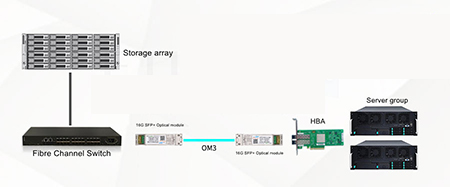
At present, the mainstream Fibre Channel switch rates are 8G and 16G. The 16G Fibre Channel switch can be matched with the 16G FC SFP+ multi-mode optical module, and then connected to the OM3 multi-mode optical fiber patch cord, from which the transmission distance can reach up to 100 meters. If the distance between the devices exceeds 100 meters, 16G single-mode optical modules can be used with single-mode fiber patch cords for transmission. The supported transmission distance can be seen in the table below.
| Product model | Product Description |
| ES85X6-3LCD01 | 16G SFP+ 850nm MM DX LC 100M |
| ES31X6-3LCD2 | 16G SFP+ 1310nm SM DX LC 2KM |
| ES31X6-3LCD10 | 16G SFP+ 1310nm SM DX LC 10KM |
| ES31X6-3LCD20 | 16G SFP+ 1310nm SM DX LC 20KM |
As the scale of storage networks continues to expand, we need to continuously upgrade to higher-speed storage networks to meet future data storage needs. We are now generating huge amounts of data every day. Storage networks of 8G and below are already difficult to support, and the emergence of 16G storage networks can further expand the bandwidth of storage networks.
Related Article:
What Is the Inventory of 100G QSFP28 Optical Transceivers Used in Data Centers
What Is a Complete List of 10G SFP+ Optical Modules
How to Choose and Apply 16G CWDM SFP+ Optical Modules
What Are the Different 10G Network Cabling Solutions Available
What Are the Differences Between 25G SFP28 SR and 25G SFP28 LR