Fiber patch cords are widely used in the field of optical communications and optoelectronics. Insertion lossand return loss are two important indicators of fiber patch cords. Insertion loss will weaken the optical power in the optical link and reduce receiving sensitivity, whilereturn loss will change the spectral width of the laser diode of the light source, introduce noise to the system, and even change the operating wavelength of the light source. Next, Walsun will analyze what is the insertion loss and return loss of the optical fiberpatch cords.
Insertion loss refers to the loss of signal power due to the insertion of a device somewhere in the transmission cable, whichgenerally refers to attenuation. It is expressed as the ratio of the output optical power of the port to the input optical power, in decibels (dB). Insertion loss is one of the standards to measure the quality of optical fiberpatch cords. The lower the insertion loss value, the better the insertion loss performance.
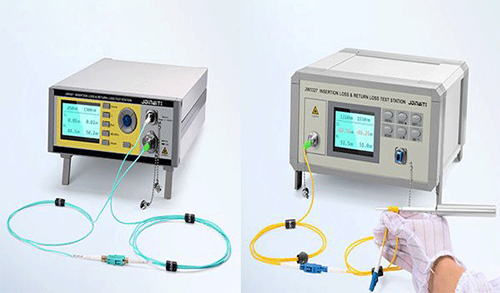
Return loss is due to the discontinuity of the transmission link, and part of the signal is reflected back to the source of the power loss during transmission. This discontinuity may be a mismatch with the terminal load, or a mismatch with the equipment inserted in the line. It is expressed as the ratio of the reflected wave power at the port of the transmission line to the incident wave power, in decibels, and the value is generally a positive value.
Therefore, the higher the absolute value of the return loss, the smaller the reflection amount, and the greater the signal power transmission, that is, the higher the return loss value, the better the performance of the optical fiber connector. The main factors affecting the insertion loss and return loss of optical fiber patch cordsare as follows:
First, the cleanliness and defects of the end face of the optical fiber, that is, scratches, pits, cracks, particle contamination, etc. on the end face, will lead to higher insertion loss and return loss.
The second is the precise mating degree of the two end faces, that is, when the fiber cores are not precisely aligned, when the connector ferrule is connected, and the alignment deviation occurs, the insertion loss and return loss will be greatly affected.
The third is the type of fiber end face. The types of fiber end face include physical contact (PC), super physical end face (UPC), and inclined physical contact (APC). Among them, the UPC connector has the lowest insertion loss due to the smallest end face air gap. The APC connector can achieve the highest return loss among the three due to the use of beveled fiber end faces.
In summary, weneeds to understand the insertion loss and return loss of optical fiber patch cords, which is conducive to the deployment of better optical transmission networks. Therefore, when we purchase fiber optic patch cords, we need to accurately measure whether the insertion loss and return loss of the fiber optic patch cord meet the requirements to ensure the normal operation of the fiber optic system.
Related Article:
What Are PCBA Board Electronic Components and How Do They Affect Performance
What Are the Advantages and Solutions for 25G-100G Spine-Leaf Network Structures
How to Integrate Alcatel-Lucent OS6860E-48 Switches with Optical Modules for Optimal Performance