Nowadays, under the rapid development of big data, artificial intelligence, Internet of Things and other network technologies, 10G network can no longer cope with the future traffic demand. In order to meet the upgrade of 10G network, and based on the low cost and high efficiency factors, 40G QSFP+ to 10G SFP+ DAC branch high-speed cable has become the preferred interconnection scheme for the short-distance 10G upgrade of 40G network.In this article, Walsun Technology (Walsun) will introduce the 40G QSFP+ to 10G SFP+ DACbranch high-speed cable.
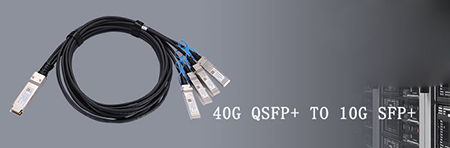
We all know that DAC direct attach cablesare mainly used for the connection between servers in data center racks and the connection between servers and switches (the height of a standard cabinet does not exceed 3 meters) or the interconnection of equipment in adjacent racks. More servers accessing high-speed switches can help reduce the number of low-speed switches and save space.
The 40G QSFP+ to 10G SFP+ DAC branch high-speed cable complies with the latest SFP+/QSFP MSA (multi-source agreement), which can build a bridge between 10G and 40G switches/host adapters. The maximum transmission rate of the SFP+ module of the 40G branch high-speed cable can be Up to 10.3125Gbps (aggregate 40Gbps). In addition, high-wire cables can reduce power budgets compared to optical fibers.
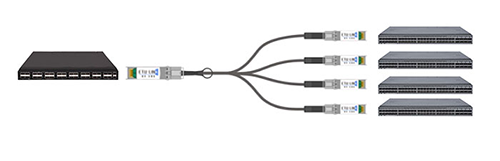
40G QSFP+ to 10G SFP+ DAC branch high-speed cable can not only realize the interconnection of 10G switch and 40G switch and the interconnection of server and switch (the interconnection of QSFP+ port of switch and SFP+ port of server network card NIC/HBA), but also the connection of switch and The interconnection of converters (transmission relays) achieves the purpose of interconnection with remote network equipment.
In addition to 40G QSFP+ to 10G SFP+ branch cables, 40G DAC high-speed cablesalso have 40G QSFP+ to QSFP+ DAC, which can be used for short-distance stacking and assembly between devices with QSFP ports. The new generation of 40G/100G data center takes a long time to prepare, so upgrading from the current 10G network is the most cost-effective way.
FAQs about FS 40G QSFP+ Transceivers
Q: What is the 40G QSFP+ transceiver max supported distance?
A: The maximum supported distance of a 40G QSFP+ transceiver can vary depending on factors such as the type of fiber optic cable used and the specific model of the transceiver. Generally, for short-range connections over multimode fiber (MMF), the maximum distance is around 150 meters. However, for long-range connections over single-mode fiber (SMF), the distance can extend up to 80 kilometers in FS.com. It’s essential to verify the specifications of the particular transceiver model and consult the manufacturer’s datasheet for accurate distance information.
Q: How to choose between QSFP-40G-UNIV and QSFP-40G-SWDM4 transceivers?
A: Choosing between QSFP-40G-UNIV and QSFP-40G-SWDM4 transceivers depends on several factors:
1. Transmission Distance: QSFP-40G-UNIV supports both short and long-distance transmission, making it versatile for various network setups. On the other hand, QSFP-40G-SWDM4 is primarily suitable for short-range applications, typically up to 300 meters over multimode fiber.
2. Fiber Compatibility: Consider the type of fiber infrastructure in your network. QSFP-40G-UNIV is compatible with both single-mode and multimode fibers, offering greater flexibility. Meanwhile, QSFP-40G-SWDM4 is specifically designed for use with multimode fibers.
3. Network Expansion: Evaluate your future scalability needs. QSFP-40G-UNIV’s compatibility with different fiber types and longer transmission distances may be advantageous for future network expansions and upgrades.
4. Cost Consideration: Assess the cost-effectiveness based on your budget and requirements. QSFP-40G-SWDM4 may be more economical for short-distance applications, while QSFP-40G-UNIV’s broader compatibility may justify its higher cost for certain scenarios.
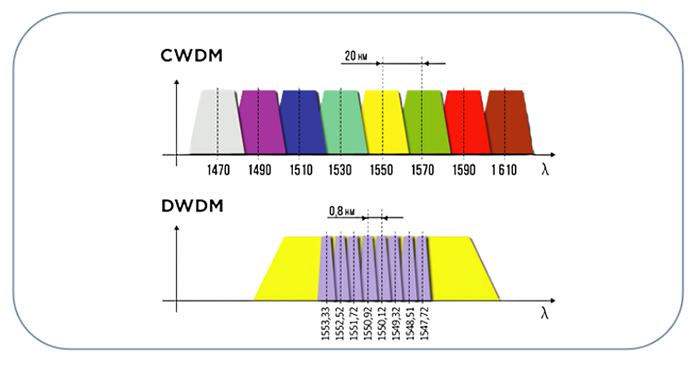
Q: Both are QSFP-40G-LR4 transceivers, what is the difference between QSFP+ CWDM and PSM?
A: The main difference between QSFP+ Coarse Wavelength Division Multiplexing (CWDM) and Parallel Single Mode (PSM) lies in their transmission technology and fiber compatibility:
1. Transmission Technology: QSFP+ CWDM utilizes multiple channels on a single fiber for transmitting and receiving signals, enabling the transfer of different data streams over distinct wavelengths of light. In contrast, PSM fiber technology employs parallel single-mode fibers, allowing simultaneous transmission over multiple individual fibers.
2. Fiber Compatibility: QSFP+ CWDM modules operate on a single fiber with multiple channels, while PSM modules use parallel fibers for each channel. This difference in fiber configuration affects their compatibility with existing network infrastructures and the ease of integration into network setups.
In summary, while both QSFP+ CWDM and PSM are QSFP-40G-LR4 transceivers designed for long-distance transmissions, their underlying transmission technologies and fiber compatibility distinguish them in terms of deployment scenarios and network configurations.
Related Article:
SFP-CWGE27-80C 1.25G CWDM SFP 1270nm 80km LC SMF DDM Transceiver Module
TRENDnet TEG-MGBS10 Compatible 1000Base LX SFP 1310nm 10km LC SMF DDM Transceiver Module
SFP-GE35-2BX20 1000Base 2 Channels BX BIDI CSFP TX1310nm-RX1550nm 20km LC SMF DDM Transceiver Module
SFP-GE55-ZX 1000Base SFP ZX 1550nm 80km LC SMF DDM Transceiver Module
SFP-DWGE17-120C 1.25G DWDM SFP C17 100GHz 1563.86nm 120km LC SMF DDM Transceiver Module