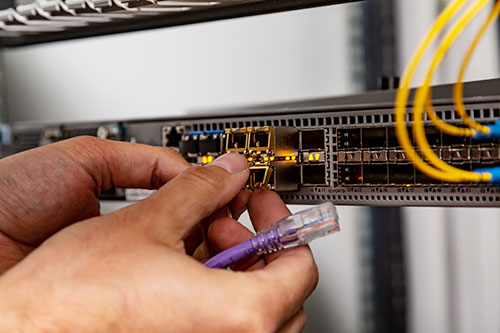
Extreme MGBIC-BX80-D Compatible 1000Base BX BIDI SFP Transceiver Module (TX1550nm/RX1490nm SMF 80km LC DDM)
Table of Contents
ToggleProduct Details
| Extreme Compatible | MGBIC-BX80-D | Vendor Name | Walsun |
| Form Factor | SFP | Max Data Rate | 1.25Gbps |
| Wavelength | TX1550nm/RX1490nm | Max Distance | 80km |
| Connector | Simplex LC | Transmitter Type | 1550nm DFB |
| Cable Type | SMF | Receiver Type | PIN |
| TX Power | 0~+5.0dBm | Receiver Sensitivity | <-26.0dBm |
| Protocols | Gigabit Ethernet, Gigabit Fibre Channel, MSA Compliant | Operation Temperature | 0 to 70°C (32 to 158°F) |
Comparison of SFP vs SFP+ vs SFP28 vs QSFP+ vs QSFP28
SFP vs SFP+
Same size with different speeds and compatibility. SFP+ is used in 10-Gigabit Ethernet applications while SFP is for 100BASE or 1000BASE applications. SFP complies with the standards of IEEE802.3 and SFF-8472 while SFP+ is based on SFF-8431. SFP+ ports can accept SFP optics but at a reduced speed of 1 Gbit/s. An SFP+ transceiver can not be plugged into an SFP port, otherwise, the product or port may be damaged. Normally, SFP+ is more expensive than SFP.
SFP+ vs SFP28
SFP+ is mainly linked to 10G, while SFP28 is commonly associated with 25G connections. They use the same form factor, and the pinouts of SFP28 and SFP+ connectors are mating compatible. So SFP28 will work with SFP+ optics but at a reduced speed of 10 Gbit/s. 10G SFP+ modules will work well with the SFP28 port on a network switch if the port can be set up for 10G transmission, otherwise, the SFP+ modules can not work.
SFP+ vs QSFP+
The primary difference between QSFP+ and SFP is the quad form. QSFP+ is an evolution of QSFP to support four 10 Gbit/s channels carrying 10-Gigabit Ethernet, 10G Fiber Channel, or InfiniBand, which allows for 4x 10G cables and stackable networking designs that achieve better throughput. QSFP+ can replace 4 standard SFP+ transceivers, resulting in greater port density and overall system cost savings over SFP+.
SFP28 vs QSFP28
SFP28 and QSFP28 transceivers actually adopt different sizes and working principles. SFP28 supports only one channel with 25 Gbit/s, while QSFP28 supports 4 separate lanes, and each is 25 Gbit/s. Both of them can be used in 100G networks, but the SFP28 is applied in the form of QSFP28 to the SFP28 breakout solution.
How to choose the suitable SFP Module for your networking? We help more than 1400 clients choose the suitable transceiver quickly. Here are the essential tips.
-
- Check your switch (or other network devices) port-supported speed and ensure it matches the correct SFP.
- Know your existing network cabling types. If you have a multimode fiber cabling structure, then choose the multimode SFP. If you have a single mode fiber cabling, a single mode transceiver is the only choice.
- Know your target link distance and link budget. But remember, choose an SFP that supports longer transmission distances than expected. Otherwise, poor fiber optic cable or a dirty fiber end face may cause a failed link.
- Considering the operating temperature, a commercial-grade transceiver is enough for a typical indoor environment. In harsh outdoor applications, you should use an industrial transceiver.
- Remember to check compatibility with the supplier before ordering. Because the switch can not recognize an incompatible transceiver, it will waste your money and valuable time. So, always choose a proven compatible transceiver.
Single Mode SFP vs Multi-Mode SFP
Single Mode SFP works using Single-Mode fibre, which has a typical core diameter of 9µm (micrometres).
It mainly works in 1310nm & 1550nm (nanometres) wavelengths, meaning it is suitable for long-distance data transmission applications, allowing distances up to 80km (providing the transceiver is capable of extended SFP).
Multi-Mode SFP works using multimode fibre, which has a core diameter of 50µm (micrometres).
The most common Multi-Mode SFP transceivers work mainly in 850nm wavelengths, which means it is more suitable for shorter transmission distances, achieving up to 500 meters, once again providing that the transceiver is capable of extended SFP.
FAQ
Q: How does the SFP differ from the GBIC module?
A: They are two different form factors and can not replace each other. GBIC is an older version of the form that is bigger. Instead, SFP utilizes a compact size, providing around double port density. In addition, it supports enhanced DDM function for easy operating status tracking.
Q: Is SFP and SFP+ compatible?
A: They are generally not compatible. Because SFP+ usually stands for enhanced SFP, it provides a high speed of 8G/10G/16G. Both modules share the same mechanical dimension.
Q: Are SFP modules vs. media converters the same?
A: Definitely different. While both serve to connect network devices and convert the copper to fiber media and vice versa, they are different. Generally speaking, the SFP transceiver can not work as a standalone device; you must install it in the SFP port of the switch and then start to work. In contrast, media converters are standalone devices that convert signals from one media type to another.
Related Article:
Dell SFP-GE-BX80-1550 Compatible 1000Base BX BIDI SFP TX1550nm-RX1490nm 80km LC SMF DDM Transceiver Module
Cisco CWDM-SFP-1270 Compatible 1.25G CWDM SFP 1270nm 40km LC SMF DDM Transceiver Module
DELL 320-2881 Compatible 1000Base SFP SX 850nm 550m LC MMF DDM Transceiver Module
Cisco GLC-EX-SMD Compatible 1000Base EX SFP 1310nm 40km LC SMF DDM Transceiver Module
Dell SFP-GE-BX40D-1490 Compatible 1000Base BX BIDI SFP TX1490nm-RX1310nm 40km LC SMF DDM Transceiver Module