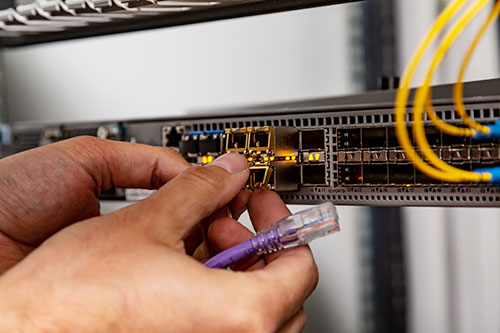
The 1000Base LX SFP transceivers are high-performance, cost-effective modules supporting a data rate of 1.25Gbps and 10km transmission distance with SMF and support up to 10km link lengths over LC duplex SMF fiber. Each SFP transceiver module is individually tested to be used on a series of Cisco switches, routers, servers, network interface cards (NICs), etc.
Product Details
| Aruba Compatible | SFP-LX | Vendor Name | Walsun |
| Form Factor | SFP | Max Data Rate | 1.25Gbps |
| Wavelength | 1310nm | Max Distance | 10km |
| Connector | Duplex LC | Transmitter Type | 1310nm FP |
| Cable Type | SMF | Receiver Type | PIN |
| TX Power | -12.0~-3.0dBm | Receiver Sensitivity | < -23.0dBm |
| Protocols | SFF-8472 MSA Compliant, IEEE 802.3ah-2004 | Operation Temperature | 0 to 70°C (32 to 158°F) |
SFP, SFP+, SFP28, QSFP+, QSFP28, What Are the Differences?
The following part will give detailed comparisons of SFP vs SFP+, SFP28 vs SFP+, QSFP vs QSFP28 and SFP28 vs QSFP28.
| Optics Type | Standard | Data Rate | Wavelength | Fiber Type | Max Distance | Typical Connector | DOM | Operating Temperature |
|---|---|---|---|---|---|---|---|---|
| SFP | SFP MSA | 155Mbps 622Mbps 1.25Gbps 2.125Gbps 2.5Gbps 3Gbps 4.25Gbps |
850nm 1310nm 1550nm CWDM DWDM BIDI |
OM1 OM2 OS1 OS2 |
160km | LC SC RJ-45 |
NO or YES | Commercial
Industrial |
| SFP+ | IEE802.3ae SFF-8431 SFF-8432 |
6Gbps 8.5Gbps 10Gbps |
850nm 1310nm 1550nm CWDM DWDM BIDI Tunable Copper |
OM3 OM4 OS1 OS2 |
120km | LC RJ-45 |
YES | Commercial
Industrial |
| QSFP+ | IEEE 802.3ba QSFP+ MSA SFF-8436 SFF-8636 Infiniband 40G QDR |
41.2Gbps | 850nm 1310nm 832-918nm |
OM3 OM4 OS1 OS2 |
40km | LC MTP/MPO |
YES | Commercial
Industrial |
| SFP28 | IEEE 802.3by SFP28 MSA SFF-8472 SFF-8432 |
25.78Gbps | 850nm 1310nm |
OM3 OM4 OS1 OS2 |
10km | LC | YES | Commercial
Industrial |
| QSFP28 | IEEE 802.3bm QSFP28 MSA SFF-8665 SFF-8636 |
103Gbps 112Gbps |
850nm 1310nm CWDM4 |
OM3 OM4 OS1 OS2 |
80km | LC MTP/MPO-12 |
YES | Commercial
Industrial |
How to Choose SFP Transceivers?
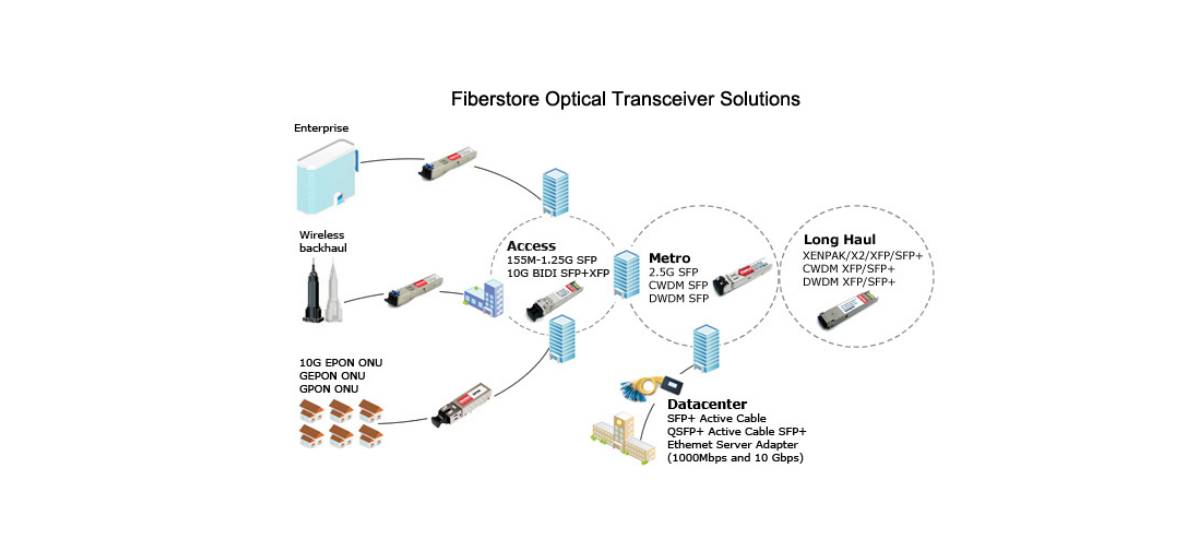
In addition to SFP, SFP+, SFP28, QSFP+, and QSFP28, you also need to consider the application. Different types of SFP transceivers depend on their purpose, such as single-mode versus multimode SFP. Single-mode SFP transceivers work with single-mode fiber, while multimode SFPs are compatible with multimode fiber. In addition, there are long-reach WDM SFP transceivers for multiplexing, simplex SFPs for single-fiber applications, video SFP transceivers for transmitting high-definition video, and PON SFPs for fiber-based access network transceivers. SFPs are available in commercial and extended operating temperature ranges, with or without extended diagnostics.
FAQs about 1G SFP Transceivers
Q: What are the features and benefits that 1G SFP transceivers can offer?
A: 1G SFP transceivers help service providers or enterprises to facilitate high-speed data transmission, and enhance network efficiency at lower cost and power. The six key benefits of 1G SFP transceivers include:
- Hot-pluggable SFP MSA compliant to maximize uptime and simplify maintenance.
- Lower latency compared to certain wireless network connections.
- Low power consumption and improved port density.
- The extensive cable distance capability renders them well-suited for long-haul applications, such as metropolitan area networks (MAN) or wide area networks (WAN).
- Loss of Signal (LOS) function provides enhancing network reliability and fault detection.
- TO coaxial packaging enables high reliability and protection of electronic components from environmental influences and mechanical stress.
- Digital Optical Monitoring (DOM) functionality supports monitoring real-time parameters such as optical output power, optical input power, temperature, laser bias current, and transceiver supply voltage.
Q: What is the 1G BiDi transceiver?
A: The 1G BiDi transceiver is proficient in bidirectional data transmission and reception at a rate of 1 gigabit per second (1G) through the implementation of Bidirectional (BiDi) technology. By utilizing distinct wavelengths for transmission and reception, BiDi technology enables simultaneous data flow on a single fiber optic cable, optimizing existing infrastructure and reducing the need for additional cabling. It supports 1000BASE Ethernet connectivity for Fast Ethernet, Telecom, and Data Centers.
Note: The bidirectional unit must be used in connection with another transceiver or network equipment that uses complementary wavelengths.
Q: What is 1G SONET/SDH transceiver?
A: The 1G SONET/SDH transceiver is a precisely developed transceiver module designed for bidirectional data transmission at 1 gigabit per second (1G) across Synchronous Optical Network (SONET) or Synchronous Digital Hierarchy (SDH) networks. The industry-standard SFP Interface Converter for Packet-Over-SONET/SDH, optical networking, and ATM applications is a hot-swappable optical interface that connects to a number of router interface ports. These c are capable of supporting OC-3, OC-12, and OC-48 data speeds in single and multimode applications with short, intermediate, and long reach distances.
Q: What are the application scenarios of 1G SFP transceivers?
A: The 1G SFP transceiver boasts remarkable efficiency with its ultra-low power consumption, making it an optimal choice for various networking environments, including Internet Service Provider (ISP) Gigabit Ethernet communication links. Additionally, its compatibility extends to Enterprise LAN & SAN Networks and Data Center LAN & SAN Networks, where its hot swappability ensures seamless integration.
Q: Are 1G SFP optics compatible with SFP+ ports at reduced speeds?
A: The compatibility of 1G SFP modules with 10G SFP+ ports depends heavily on the switch’s exact model. In general, SFP+ slots are compatible with SFP modules. However, they often do it at a slower pace of 1Gb. In some cases, the SFP+ port may limit the speed to 1Gb until you reboot the switch or issue specific commands. It is vital not to forget that SFP+ ports normally do not allow speeds less than 1G. As a result, an SFP+ port cannot fit a 100BASE SFP module.
Before inserting an SFP transceiver into an SFP+ port on a 10Gb switch, make sure the switch’s vendor or the thorough documentation available in the official front-end interface supports dual rates. This will help to ensure flawless network operation.
Q: What is the SFP Port on Gigabit Switch?
A: A Gigabit switch’s SFP port is a slot designed to accept SFP connectors and enable data transmission. It offers both high speed and physical compactness. The SFP port allows optical or copper connectivity on a Gigabit switch by inserting the appropriate SFP modules (fiber SFP or copper SFP). When an SFP module is installed into a Gigabit switch with electrical ports, network cables such as Cat5e /Cat6 /Cat7 are required for data transmission. However, when an SFP module is put into a Gigabit switch with optical ports, fiber optic cables are required to support connections.
Related Article:
Arista Networks SFP-1G-SX-2 Compatible 1000M SFP SX 1310nm 2km LC MMF DDM Transceiver Module